


WAR THREATENS GLOBAL STAGFLATION – AI AGENTICS: BUSINESSES ADAPT OR DISAPPEAR – TRANSFORMS HOW ECONOMY TAXED – CAPITAL DEMANDS FORCE GIANTS PUBLIC – DISRUPTION FAVORS QUALITY INVESTMENTS
Key Point Summary
- War Disrupts 2026 Outlook—Threatens Global Stagflation
- Fracking Revolution Turns Middle East Supply Shock into U.S. Export Gain
- Hormuz Disruption Starves Europe and Asia of LNG—U.S. Exporters Win
- Data Centers Spend Trillions—Agentic AI Harvests the Gains
- AI Agentics Rewrites the Business Playbook—Adapt or Disappear
- AI Erodes Employment Tax Base—Transforms How Economy Taxed
- Private Markets Boom—But Capital Demands Force Giants into Public Markets
Investment Conclusions
- Energy Prices Shrink Consumer Spending—Lackluster Short Term Markets—AI Strengthens Long-Term Outlook
- Disruption Reinforces Diversification — Favor Quality
- Domestic Equities—Alternative Energies
- Domestic Equities—Small/Mid-Cap (SMID) Companies Hurt if Fed Holds Rates
- Domestic Equities—Defense Spending—Next Generation Warfare—Ukraine Important Source
- Domestic Equities—Reshoring—Industrial Companies and Transportation Systems Benefit
- International Equities—Stronger Dollar—Short-term Negative for International Markets
War Disrupts 2026 Outlook—Threatens Global Stagflation
Investors entered 2026 expecting a positive first quarter GDP, driven by higher-than-normal tax refunds and hopes for calm following 2025’s “Liberation Day” tariff turbulence. The Iranian conflict quickly shattered that outlook and continues to further reshape global political and economic forces. One key question dominates: will the war prove protracted? A protracted war will deliver a major economic shock, driving stagflation particularly for Asia and Europe.
Fracking Revolution Turns Middle East Supply Shock into U.S. Export Gain
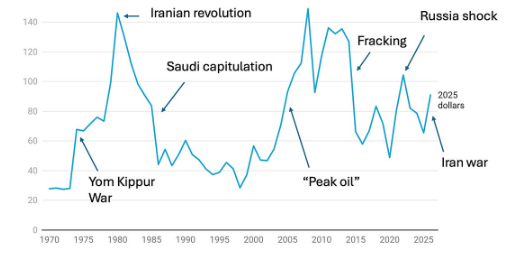
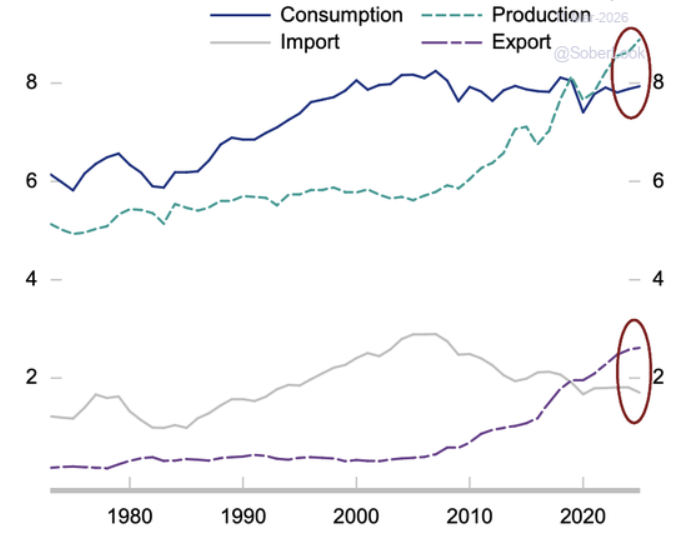
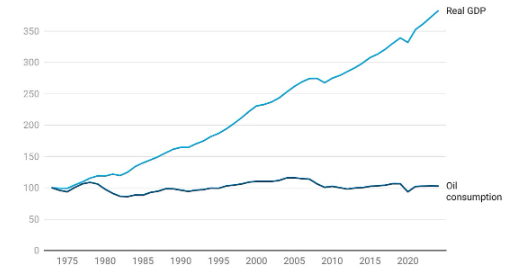
The 1973 Middle East oil embargo lasted about five months, forcing gasoline rationing as the U.S. imported roughly 30% of its oil. Since then, supply disruptions drove real oil prices higher (see Figure 1). The fracking revolution transformed the U.S. from a net energy importer into a net exporter (see Figure 2). Over that same period, the U.S. economy shed its oil dependence and grew nearly four times larger while consuming no more oil than in 1973 (see Figure 3). A Hormuz closure spikes global energy prices, but, unlike 1973, the U.S. secures sufficient domestic oil and gas supplies and also capture export gains at higher prices.
Figure 1
Real Oil Price
Sources: FRED, Paul Krugman
Figure 2
U.S. Primary Energy (Btus, Qd)
Sources: U.S. Energy Information Administration, mrb partners
Figure 3
Growth in U.S. Real GDP and Oil Consumption
(Index 1973=100)
Sources: FRED, World in Data, Paul Krugman
Hormuz Disruption Starves Europe and Asia of LNG—U.S. Exporters Win
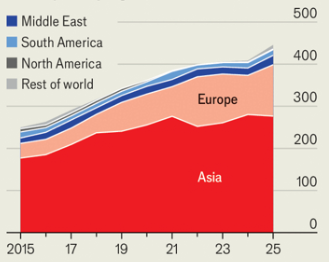
Twenty percent of global LNG shipments pass through the Strait of Hormuz. Europe and Asia depend heavily on Persian Gulf LNG imports for electric generation, making supply disruptions likely more damaging to their economies than reduced oil supplies (see Figure 3). The LNG shortage will hit Southeast Asia hardest as warming weather drives demand higher (see Figure 4). Meanwhile, American Gulf export terminals ship gas to both Europe and Asia, where the highest bidders redirect LNG shipments after they leave Gulf ports.
Figure 4
LNG Imports by Region From the Persian Gulf, metric tonnes
Sources: Rystad Energy, THE ECONOMIST
Data Centers Spend Trillions—Agentic AI Harvests the Gains
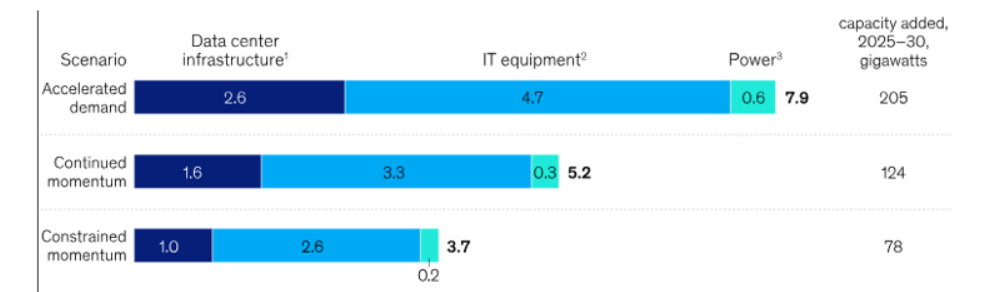
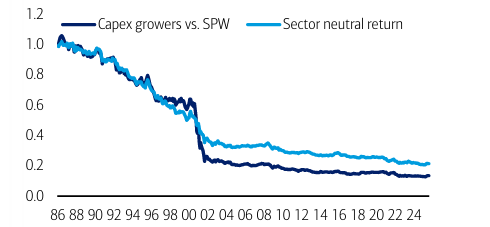
Despite higher energy prices threatening stagflation, massive hyperscale data center investments counter that threat and position the U.S. to grow. Bain estimates data centers will need to generate $2 trillion in annual revenue by 2030 to deliver returns on their $4-7 billion investments (see Figure 5), against current estimated revenues below $75 billion. Agentic AI—autonomous, multi-step decision-making systems—drives data center revenues, as companies expect these systems to sharply enhance productivity and returns. The question remains whether that revenue curve will accelerate sufficiently to justify the enormous investments in data centers. History suggests returns will reward companies that deliver alternative products and services such as Agentic AI systems rather than those sinking capital into heavy data center investments (see Figure 6).
Figure 5
Global Investments to Support AI-Related Data Center Capacity Demand
Source: McKinsey & Company
Figure 6
Relative Performance of Top Decile in LTM Capex YoY vs. the
Equal Weighted S&P 500 (1986-9/25)
Sources: BofA Equity & Quant Strategy, FactSet
AI Agentics Rewrites the Business Playbook—Adapt or Disappear
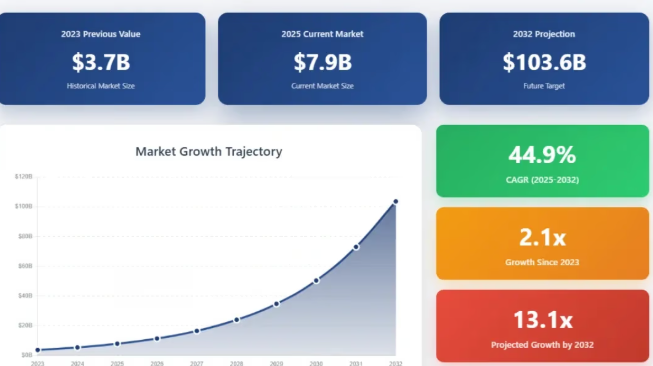
Growing use of AI Agentics will drive exponential AI adoption, delivering first disinflation, then outright deflation before a decade’s end. Agentic AI powers this digital transformation (see Figure 7). Businesses that adapt will capture expanding margins and gain efficiency, building competitive advantages. Those that fail will face extinction.
Figure 7
AI Agents Market Growth
Source: Tenet Global
AI Displaces White-Collar Workers—Sparking the Next Populist Uprising
This transformation will likely move faster than any comparable past shift, displacing significant numbers of white-collar workers. That displacement will likely trigger social disruption, igniting a populist backlash similar to the one automation and low-priced Chinese imports sparked when they eliminated blue-collar jobs. This time, white-collar workers will broaden and intensify the populist political movement.
AI Erodes Employment Tax Base—Transforms How Economy Taxed
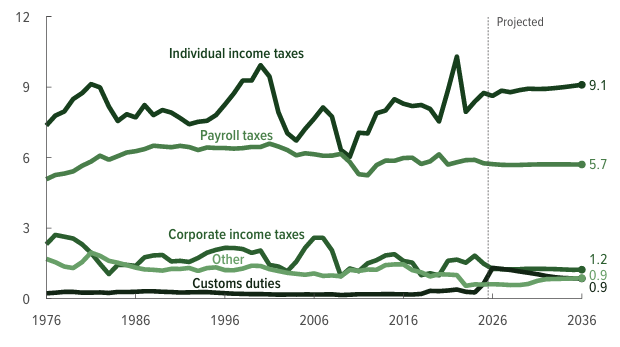
Individuals generate roughly $2.7 trillion in federal tax revenue annually while corporations contribute $400 billion (see Figure 8). If AI erodes the employment and tax base, policymakers will face mounting pressure to target capital rather than labor through higher corporate or new wealth taxes. For those with significant capital, the AI revolution will restructure the economy and most importantly, transform how that economy gets taxed.
Figure 8
Federal Government Revenues, by Category
Percentage of GDP*
*2026 Nominal GDP Estimate $33-35 Trillion
Source: Congressional Budget Office
Private Markets Boom—But Capital Demands Force Giants into Public Markets
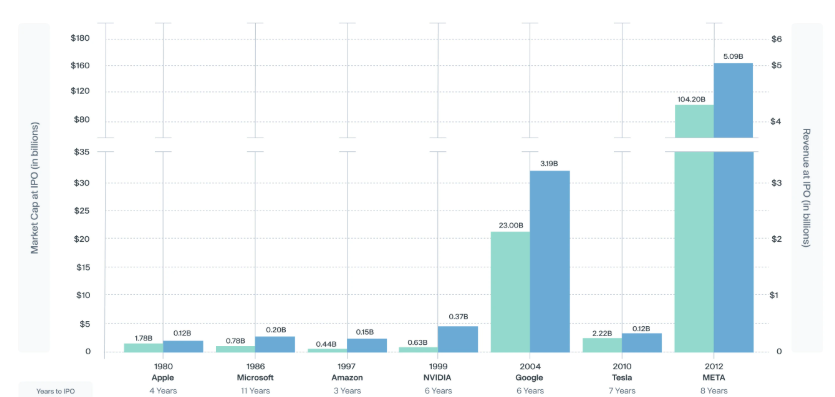
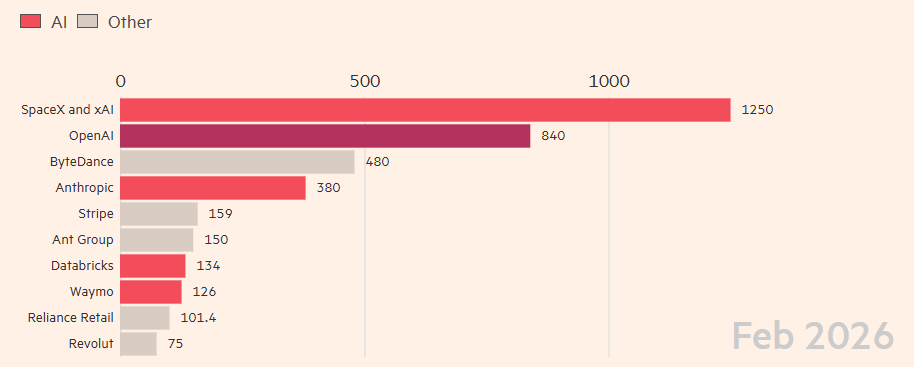
Private global secondary transaction volume soared from $50 billion in 2014 to $225-240 billion in 2024, enabling companies to stay private for longer—over ten years—while avoiding public market regulatory and reporting requirements. Yet private companies can only delay so long before their sheer size eventually demands capital that only public markets can supply (see figure 9). Three privately funded giants—SpaceX, Open AI, and Anthropic—prepare to go public, potentially making 2026 an historic IPO year (see Figure 10). Nonetheless, private secondary market growth and liquidity will continue driving companies to stay private longer, with only the most consequential companies choosing to go public.
Figure 9
IPO Stats for the Mag 7: Market Cap vs Revenues/Years to IPO
Source: Forge Insights
Figure 10
Top-value Private Companies Post-Money Value—Feb 2026 ($bn)
Source: Financial Times
Investment Conclusions
War Replaced First Half Optimism: Six weeks ago, our Commentary optimistically anticipated upside risk for economic forecasts, expecting substantial tax refunds to boost first-half growth. Quite a change in only six weeks. The economy now points toward modest first half growth, pushing markets toward lackluster performance.
Energy Prices Shrink Consumer Spending—Lackluster Short-Term Markets—AI Strengthens Long-Term Growth Outlook: The direction of the equity market could also prove key to consumer spending. The negative wealth effect of lackluster markets would shrink high-income spending — a key driver of consumer spending that powers nearly 70% of GDP. Higher energy prices consume a larger share of lower-income household budgets, both combined pulls spending from discretionary goods and consumer services. Together, these forces would drive a more cautious outlook for the economy and markets in the second half. However, accelerating generative AI investment accelerates long-term economic growth and strengthen positive deflationary forces.
Disruption Reinforces Diversification—Favors Quality: Recent disruptions underscore the importance of portfolio diversification. Current events will likely elevate the importance of quality investments across both equity and fixed income performance.
Domestic Equities—Alternative Energies: Higher energy prices and accelerating data center investments drive demand for alternative energies—near-term solar and longer-term nuclear.
Domestic Equities—AI Hardware Shortage—Plus for Chip Producers/Semiconductor Capital Equipment: Hyperscale data center spending creates AI hardware shortages. Continuing to strengthen the attractiveness of chip suppliers and semiconductor capital equipment companies.
Domestic Equities—Small/Mid-Cap (SMID) Companies—Hurt if Fed Holds Rates: Futures markets anticipated Fed rate cuts earlier this year, but the war changed that outlook—markets now expect the Fed to hold rates steady. That likelihood, combined with economic uncertainty, reduces the attractiveness of SMID stocks, which carry a higher percentage of floating rate debt.
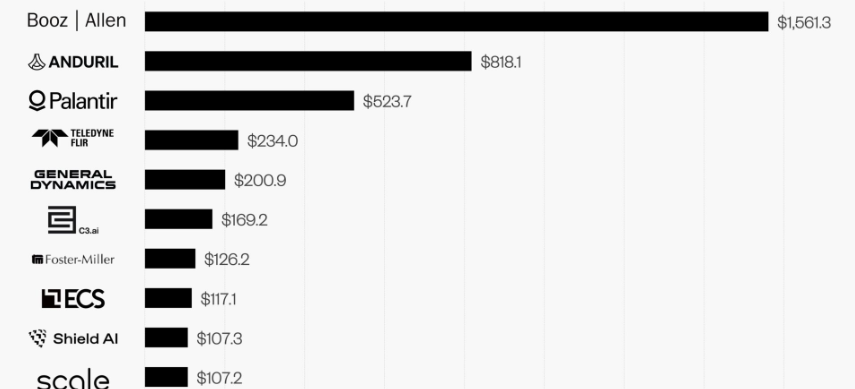
Domestic Equities—Defense Spending—Next Generation Warfare—Ukraine Important Source: Present conflicts in the Middle East and Ukraine will push the U.S. DOD/W budget past $1trillion, with the Defense Innovation Unit gaining a 10% increase for FY26. Ukraine will a source of critical asymmetric warfare technology. Modernized defense procurement process accelerates contracting. Most importantly, defense spending will move from traditional defense companies to a new generation of public and private companies (see Figure 11). Investors should target non-traditional public and private defense companies building the next generation of warfare.
Figure 11
Select AI and Autonomous Systems DOD/W Contract Values by Company ($M)
Sources: Chronograph, Follow the Money
Domestic Equities—Reshoring—Industrial Companies and Transportation Systems Benefit: The current Middle East military operation further disrupts geopolitical and economic forces. Combined with supply chain and trade frictions, these forces likely accelerate reshoring, driving a North American industrial rebirth that strengthens industrial companies and north-south transportation suppliers.
International Equities—Stronger Dollar—Short-term Negative for International Markets:
The conflict drove investors to the safety of the U.S. dollar, weighing on emerging market investments and precious metals near-term. Longer-term, this period offers an opportunity to diversify into non-U.S. markets through actively managed funds that experienced global managers lead—managers who invest selectively in Europe and broadly across Asia/Pacific. Target non-U.S. defense companies that gain from increased national security spending in both regions and from Persian Gulf states boosting defense budgets in response to this war.