


U.S.-Israeli Military Operations in Iran: Market & Portfolio Implications
The U.S.-Israeli military operation will drive significant long-term geopolitical change. The central question — whether this conflict proves limited or protracted — remains open. The President projects a limited war; however, the conflict will reshape already-disrupted global political and economic forces regardless of its duration.
Base case: A limited war. We assess the macro implications below on that assumption, while acknowledging that escalation risk warrants monitoring.
ENERGY MARKETS
Under a limited-war scenario, oil prices will likely rise by $10–$20/bbl. Two structural factors limit the inflationary impact relative to historical oil shocks:
- Reduced oil dependency across developed economies softens the macroeconomic transmission of higher energy prices.
- U.S. fracking technology has transformed America into a major net exporter of oil and LNG. Higher prices benefit domestic producers rather than acting as a pure tax on the economy.
The critical medium-term variable is the stability of Iranian production and export capacity once the conflict ends. The Federal Reserve estimates that a 10% rise in crude oil prices pushes near-term PCE inflation up by approximately 10 basis points.
Energy Share in the CPI (%)
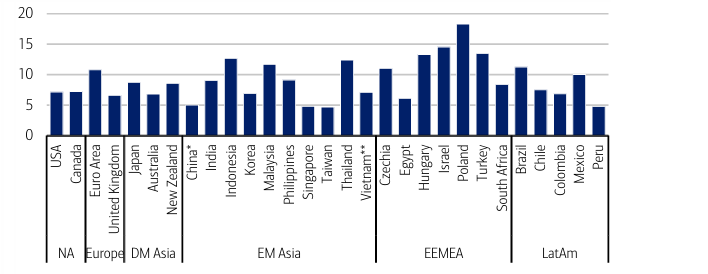
Sources: BofA Global Research, Haver
CRITICAL SHIPPING CHOKEPOINTS
The conflict directly threatens two chokepoints that together handle a substantial share of global energy and trade flows:
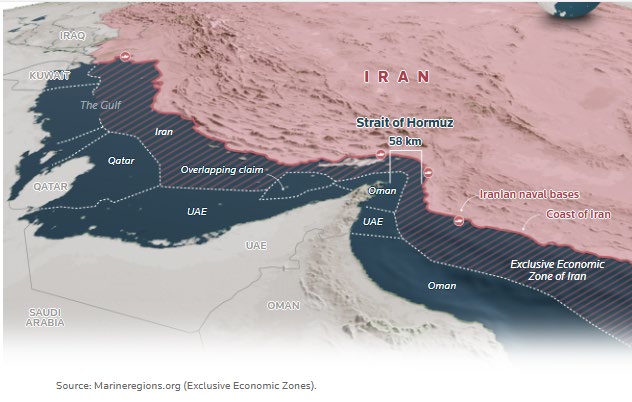
Strait of Hormuz
- Roughly one-quarter to one-third of global seaborne oil trade transits the Strait.
- Qatar and other regional producers route approximately 20% of global LNG supply through Hormuz.
- U.S. and allied naval forces should sustain energy flows through the Strait, particularly as Iran’s naval capacity erodes through the conflict.
STRAIT OF HORMUZ/PERSIAN GULF
Bab-el-Mandeb Strait
The Houthis — an Iranian-backed proxy force — continue to threaten this roughly 25-milewide passage between the Horn of Africa and Yemen. In normal conditions, 10–12% of all global seaborne trade transits Bab-el-Mandeb, linking Asia and Europe via the Red Sea and Suez Canal. Disruption carries several consequences:
- Rerouting supply chains around the Cape of Good Hope substantially increases shipping costs.
- Higher shipping costs export inflationary pressure to Europe while lifting trans-Pacific freight rates and contributing to U.S. inflation.
- Persistent disruption strengthens the economic and strategic case for nearshoring and reshoring of production.
ECONOMIC & MARKET IMPLICATIONS
The potential for a sustained equity market decline driven by the conflict could trigger a negative wealth effect on high-income consumer spending — a segment that accounts for roughly 70% of GDP – powered by consumer expenditure. Simultaneously, higher energy prices consume a larger share of lower-income household budgets, shifting spending away from discretionary goods toward staples. Together, these forces reduce the outlook for economic growth and increase the risk of short-term inflation.
Ratio of Lower- and Higher-Income Discretionary Spending to Middle-Income Discretionary Spending
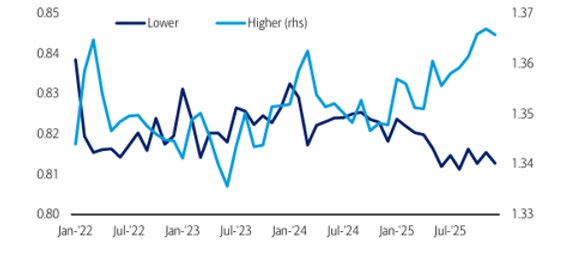
Sources: BofA Global Research, BAC aggregate card data
PORTFOLIO IMPLICATIONS
Heightened geopolitical risk naturally drives concern about market volatility. Our core guidance:
- Maintain broad diversification consistent with your long-term objectives. Portfolios constructed on this basis are designed to absorb sudden macroeconomic shocks.
- Geopolitical dislocations create asymmetric risk/reward opportunities. We are actively evaluating areas where market dislocations may generate attractive entry points to complement existing allocations.
We will continue to monitor developments and update you as the situation evolves. Please feel free to contact us if you have any questions.
Disclaimer
This information was prepared by SkyView Investment Advisors, LLC (“SkyView”), a federally registered investment adviser under the Investment Advisers Act of 1940.
This document is intended for internal use only and, in certain exceptions, for the exclusive use of clients or prospective clients of SkyView. Content is privileged and confidential. Any dissemination or distribution is strictly prohibited. The enclosed materials are not an offer to sell nor a solicitation of an offer to purchase interests of any current or future related fund, nor do they constitute a financial promotion, investment advice, or an inducement or incitement to participate in any product, offering, or investment. The enclosed materials may not be reproduced or redistributed in whole or in part. SkyView disclaims any obligation to update this document to reflect subsequent developments. Each person accepting the enclosed materials thereby agrees to return them promptly upon request.
No representation, warranty, or undertaking, express or implied, is given as to the accuracy or completeness of the information or opinions contained in the enclosed materials by SkyView or respective affiliates or employees, and no liability is accepted by such persons for the accuracy or completeness of any such information or opinions. Strategies discussed herein may involve investments in less liquid securities as well as leverage. Due to the potential volatility of net asset values, these products are intended for sophisticated investors. You and your advisor(s) should consider any legal, tax, and accounting matters relevant to any investments discussed herein or arising therefrom. If you are subject to ERISA regulations, this presentation is being furnished to you on the condition that it will not form a primary basis for any investment decision. There can be no guarantee that investment objectives will be obtained. In making an investment decision, you must rely on your own examination of the investments and the terms of the offering. You should not construe the contents of the enclosed materials as legal, tax, investment, or other advice.