


Trump Gap Years Underpin New Policies — Personal Presidential Trade Deals — Changes on Whim — Treasury Greater Influence on Fed — Focus on AI Investments Beyond “Mag 7” and 3–5 Year T-Notes
KEY POINTS SUMMARY
1. Trump’s Gap Years Underpinned Aggressive New Policies—The Fed Next
2. Trade Deals–Personal Presidential Agreements — Changed at a Whim
3. Low Immigration Reduces “Breakeven” Job Growth Needed to Steady Unemployment
4. Fed Aggressive Policy Shift—Raises Inflation Concerns
5. GENIUS Act Drives Demand for Short-term Treasuries
6. The Treasury Seeks Greater Influence on the Fed
7. Investment Conclusions—AI Spending Outweighs Trump Policy Shifts
8. Domestic Equities- Beyond “Mag 7” or Diversified Portfolios
9. International Equities—U.S. Multinationals an Alternative
10. Fixed Income-Focus on Short-Intermediate Duration Treasury Notes
Trump’s Gap Years Underpinned Aggressive New Policies—The Fed Next
Trump’s gap years between administrations enabled his team to leverage first term experience and rapidly implement policy plans in the initial months of his second term. They prioritized completing their legislative agenda well before the mid-term Congressional elections, enacting the OBBBA swiftly despite pushback from within their party. More dramatic actions may follow with restructuring the Federal Reserve and pursuing more aggressive monetary policies.
Trade Deals Now Personal Presidential Agreements — Easily Changed
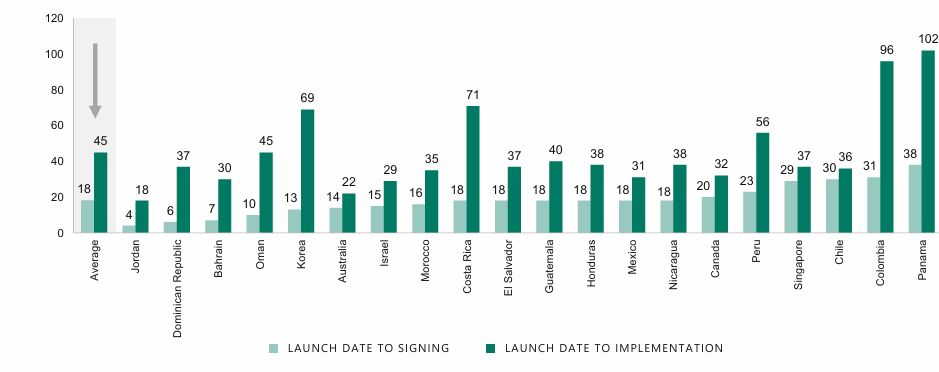
Trade deals once took years to sign and implement requiring Congressional approval (see Figure 1). Today, trade agreements simply act as personal Presidential deals without such approval, allowing either side to alter or cancel them at will. President Obama struck a personal deal with Iran–the nuclear deal (JCPOA)–without Congressional approval. President Trump later terminated it during his first term. These experiences prompt foreign partners to approach U.S. agreements cautiously, aware any administration can reverse or cancel them. It can also lead to future surprises for investors caught unaware.
Figure 1
Duration of U.S. Trade Negotiations
(Number of Months)
Sources: PIIE, Apollo Chief Economist
Intermediate Goods Tariff Increases Delay Consumer Price Increases
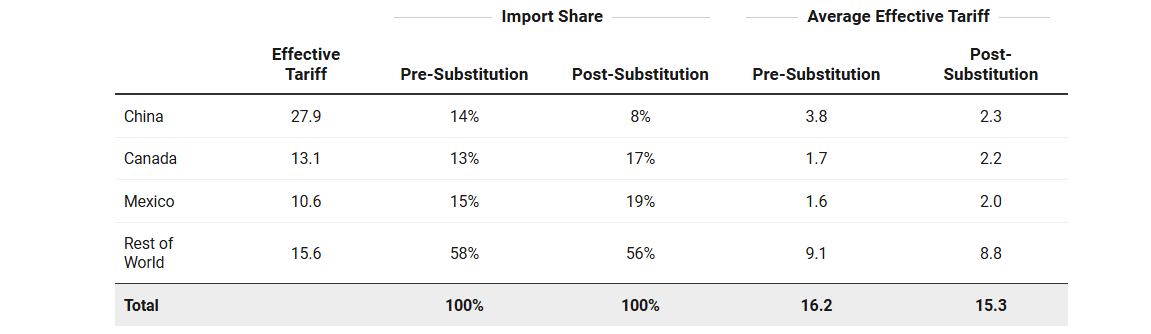
The July core CPI (+3.1%) and PPI (+3.3%) reports showed year-over-year increases, with surprisingly stronger inflation from core services than goods. Tariff increases on intermediate goods, about half of U.S. imports, likely delay consumer price impact until final products reach consumers. Figure 2 shows how higher tariff rates drive substitution and shift import shares by country. Shifting to imports from Mexico and Canada under the USMCA reduce tariffs’ inflationary impact. Tariff hikes will likely raise consumer prices later this year, or companies may delay increases until their January annual adjustments, to temper White House reactions, squeezing fourth-quarter profit margins.
Figure 2
Average Effective U.S. Tariff Rate, New 2025 Policy
(Pre- and post-substitution through August 6th)
Sources: The Budget Lab Analysis, GTAPv7
Low Immigration Reduces “Breakeven” Job Growth Needed to Steady Unemployment
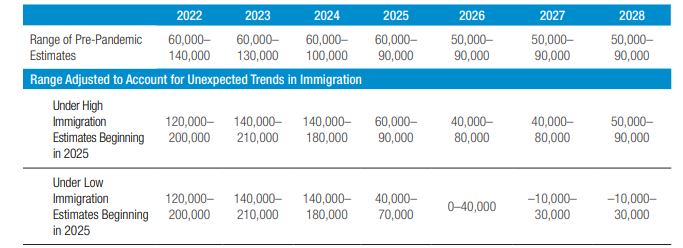
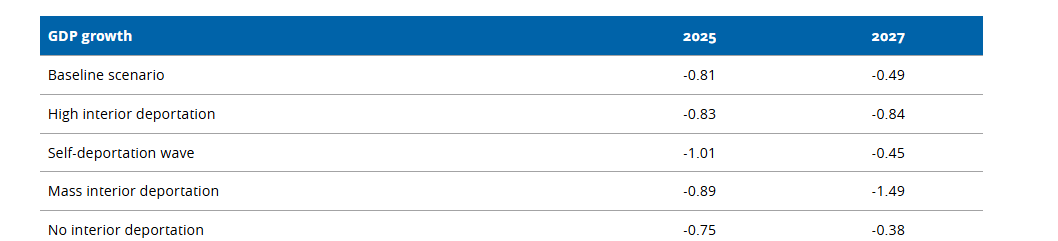
U.S. net immigration plunged by over 80% from late-2024, reducing the foreign-born population by an estimated 2.2 million in 2025 (see Figure 3). The American Enterprise Institute estimates that low immigration lowers “breakeven” payroll growth to 40,00070,000 while Goldman Sachs Economics sets it at 80,000 (see figure 4). These estimates reduce the “breakeven” job creation needed to maintain steady unemployment, suggesting that since July’s 73,000 job growth falls within this range, it may not signal significant weakness. Slower workforce growth may sustain higher service inflation, as July CPI/PPI results show. The Dallas Fed estimates reduced unauthorized immigration will cut GDP growth below the 2% benchmark by 0.81% this year and 0.49% in 2027 (see Figure 5). Slower workforce growth will speed future humanoid robotics demand.
Figure 3
Foreign-born Population (000)

Sources: Current Population Survey January 2021-July 2025, Center for Immigration Studies
Figure 4
Potential Employment Growth, Monthly
Source: American Enterprise Institute, BLS, CBO, Social Security Administration
Figure 5
Effects of Immigration Shocks on GDP
Source: Dallas Fed Economics
AI Boosts Long-Term Productivity– Would Ease Burden of Federal Debt
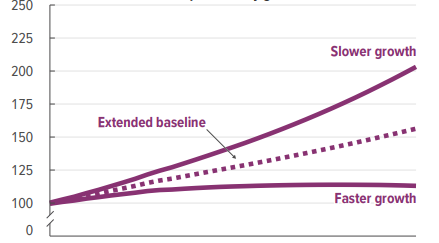
If advanced AI-driven automation closely meets realistic forecasts by the middle of the next decade, companies will increase output, accelerate productivity, and slow inflation despite a stagnant workforce. This shift benefits a wider range of companies over the long term, as witnessed in the electric utility industry. Under this scenario, the Congressional Budget Office projects that a 0.5% increase in annual productivity–compared to its base forecast of 1%– reduces the federal debt burden from 156% of GDP to 113% (see Figure 6).
Figure 6
If Total Factor Productivity Growth Differed from the Baseline
(% of GDP)
Source: Congressional Budget Office
Fed Aggressive Policy Shift—Raises Inflation Concerns
The Federal Reserve likely undergoes major restructuring with a new Chair and Governor. The new Fed Chair and three Trump–appointed members-subject to critical Congressional approval- will likely drive the Federal Open Market Committee to accelerate funds rate cuts to the presumed neutral rate of around 3%. This shift would raise investor concerns about the Fed’s commitment to its inflation goals and likely increases the term premium (see Figure 7). This scenario could steepen the yield curve at comparable short-term interest rates—benefiting financial companies.
Figure 7
10 Year Treasury Term Premium*
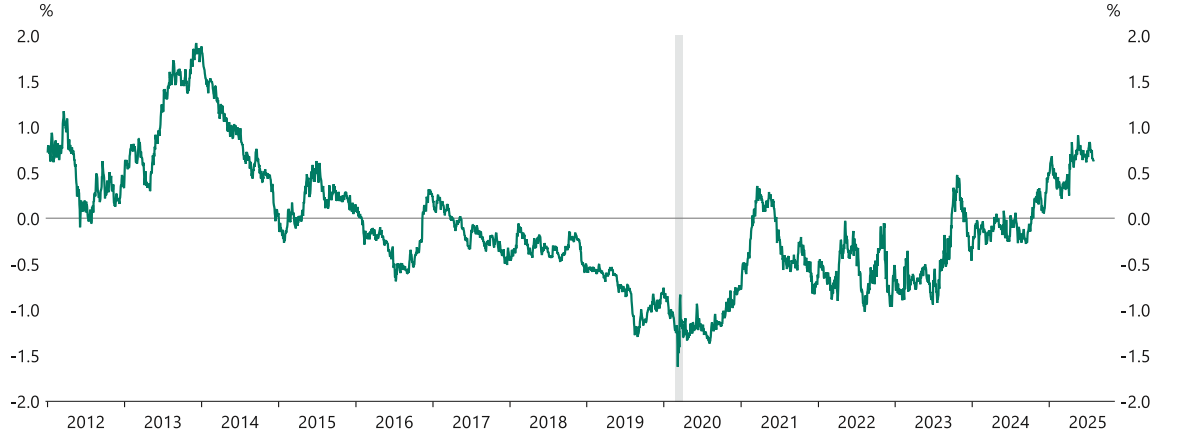
*Extra return to compensate for risk associated with a long-term bond
Sources: Apollo Chief Economist, Federal Reserve Bank of New York, Macrobond
GENIUS Act Drives Demand for Short-term Treasuries
The GENIUS Act, mandating Treasury reserves behind stablecoins, could also steepen the yield curve by generating incremental demand for short-term Treasuries. This demand could lower short-term interest costs for the Treasury amid rapidly growing deficits. Consequently, the Treasury may rely more heavily on short-term paper to finance federal borrowing.
The Treasury Seeks Greater Influence on the Fed
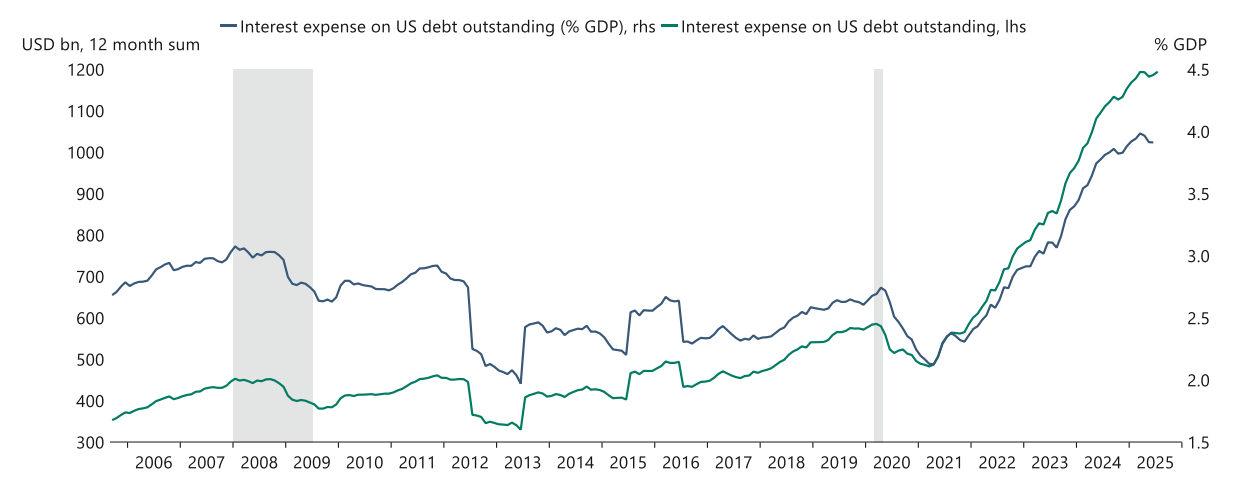
Rising interest costs (see Figure 8) may lead the Treasury to apply a broader influence over the Fed and monetary policy to reduce borrowing costs. These efforts may not only lower fed funds rates but expand the Fed’s balance sheet. If this occurs, concerns about the Fed’s independence might weaken the U.S. dollar further and trigger a shift toward hard assets, including precious metals and digital assets.
Figure 8 U.S. Federal Debt Servicing Costs
Sources: Apollo Chief Economist, U.S. Treasury, Bloomberg, Macrobond
Investment Conclusions—AI Spending Outweighs Trump Policy Shifts:
Investors will continue to monitor the economic impact of Trump’s key polices— OBBBA and tariff/trade “agreements.” Meanwhile, companies invest heavily in hyperscale data centers, likely doubling capacity by decade’s end to meet demand. AI will likely reshape the economy long-term more profoundly than the two policies by boosting productivity, driving deflationary forces to counter deglobalization, and strengthening the U.S. economic outlook. So far, equity investors affirm this view with premium valuations for AI-driven stocks. With stagnant workforce growth, AI will brighten an otherwise cloudy economic outlook. The key question focuses on the timing and returns for these previously asset-light companies as they rapidly increase their capital investments.
Domestic Equities—Broaden Beyond “Mag 7” or Diversified Portfolios:
AI’s positive long-term outlook should prompt investors to look beyond the “Mag 7” favorites and identify sectors and companies–public and private–that will benefit as AI use broadens across industries and sectors. Steeper yield curves will benefit financials. With high equity multiples and a narrow market, cautious investors should favor more diversified portfolios with quality firms that sustain above-average earnings growth and maintain strong balance sheets while accelerating dividend payouts and share buybacks.
International Equities—U.S. Multinationals an Alternative: Rising U.S. uncertainty boosts interest in international equities. U.S. multinationals with sizeable foreign revenues, including several tech companies, offer a conservative global investment alternative, especially when the U.S. dollar weakens.
Fixed Income-Focus on Short-Intermediate Duration Treasury Notes: Rising budget deficit financing will likely sustain elevated long rates. As the gap between U.S. corporate and Treasury yields narrows to its smallest level since 1998, investors should focus on short-intermediate duration Treasury notes.
Alternatives–Diversification Benefits: Amidst changes in the financial industry and markets, alternatives offer the opportunity to engage in these changes by selectively investing in the growing use of private credit.