


Striking Down Tariffs Won’t Restore Pre-“Liberation Day” State — Data Center/AI Investment Drives Growth—Challenges Returns
Commentary—Key Points Summary
1. Striking Down Tariffs will not Restore pre-“Liberation Day”
Geopolitical and Economic State
2. Data Center/AI Investment Drives Growth—Challenges Returns
3. “Mag 7” Reallocates Cash Flow from Buyback to Capex
4. Smaller Models Enhance AI Growth—VC and IPOs Grow in Size
5. Immigration Limits and Low Churn Cloud Job Growth
6. Strong Equity Markets Support Higher Consumer Spending
7. Explore AI Equities Beyond “Mag 7”
8. Narrow Equity Markets Diversify Portfolios
9. Global—U.S. Multinationals and European Defense Indices
10. Fixed Income—Intermediate Treasuries and Agency Paper
11. Selective Private Credit Attractive Compared to Public Debt Market
12. Gold Addendum—“Financialization of Warfare”
Striking Down Tariff Policies Will Not Restore pre-“Liberation Day” Geopolitical and Economic State
Even if the Supreme Court strikes down current tariff policies under the IEEPA, it will not
restore the pre-“Liberation Day” geopolitical and economic state. If the Court rejects the
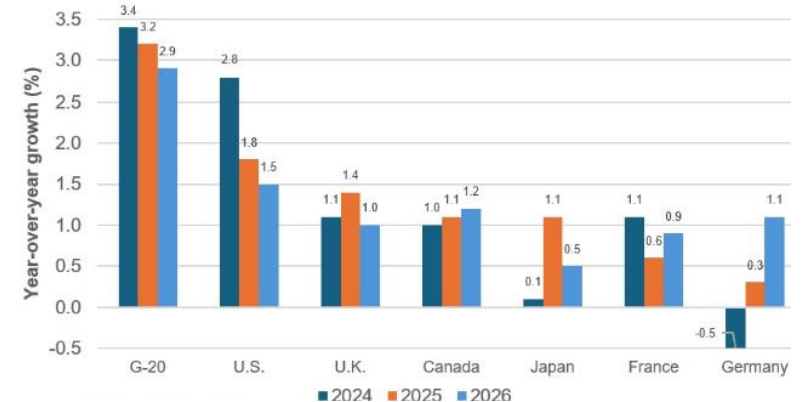
appeal, the government will forfeit about $2 trillion in revenue through Fiscal Year 2035 (see Figure 1.) Heightened global uncertainty may influence gold prices (see our addendum on gold) and prompts the OECD to moderate its world growth forecast (see Figure 2.) This uncertainty may dampen domestic capital investment, with one major exception; companies will continue investing in data centers.
Figure 1
More than Half of FY 2025 Tariff Revenue Comes from IEEPA

Sources: U.S. Customs and Border Protection, Tax Foundation calculations
Figure 2
Projected Global Economic Growth
Source: OECD Interim Economic Outlook, RSM US LLO
Data Center/AI Investment Drives Growth — Challenges Returns
Trade policy shifts heighten normal uncertainty. However, hyperscale data center and AI spending offsets it and fuels economic growth. McKinsey projects $3- $8 trillion in total data center spending (see Figure 3.) A ten-year average depreciation raises questions about potential returns, assuming $300-800 billion in annual depreciable costs. Companies also must determine how to depreciate expensive chips with 3-5 year lifespans. Barclays Bank estimates higher depreciation costs could reduce earnings per share by 5-10% for Alphabet, Amazon, and Meta. Nonetheless, chip and other “picks and shovels” suppliers will profit significantly. AI and data center investment will propel economic growth and reward suppliers despite uncertain returns.
Figure 3

Source: McKinsey Data Center
“Mag 7”Reallocate Cash Flow from Buybacks to Capex
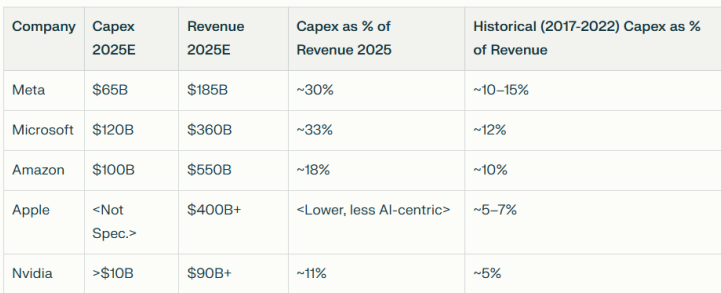
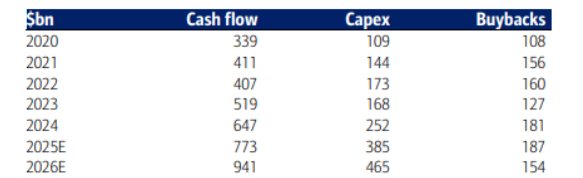
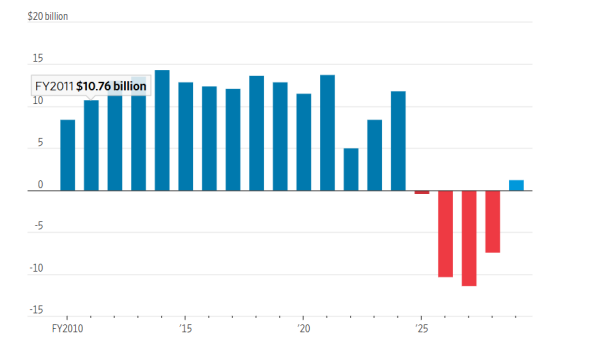
The “Mag 7” dominated as asset-light companies with strong software and platform margins and modest capex-to-revenue ratios. That label no longer fits. These companies reallocated their use of cash flow from buybacks to capex, sharply increasing their capex as a share of revenues. (see Figures 4 and 5.) Oracle illustrates this shift by investing all of its operating cash flow in AI computing capacity, turning its historically positive cash flow negative for the next four years (see Figure 6.) AI’s outlook appears very positive, but investors will judge success by the returns these companies eventually earn on their investments.
Figure 4
Capex/Revenue Ratios
Source: Perplexity
Figure 5
“Mag 7” Capex Reallocation to AI Investment
Sources: BofA Global Strategy, Bloomberg, BofA estimates
Figure 6
Oracle’s Free Cash Flow per Fiscal Year
(May FY 26-29 Projections)
Source: The Wall Street Journal, Visible
Smaller AI Models Drive Growth—VC and IPOs Grow in Size
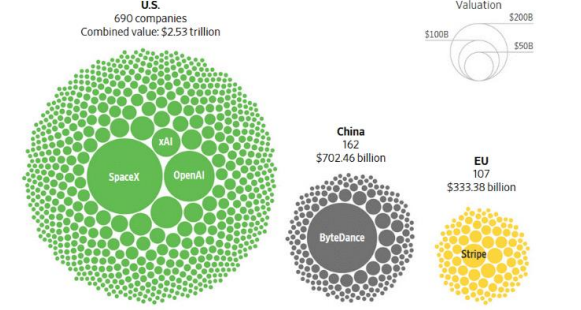
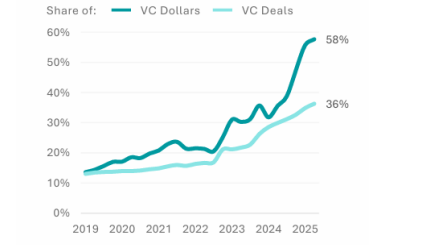
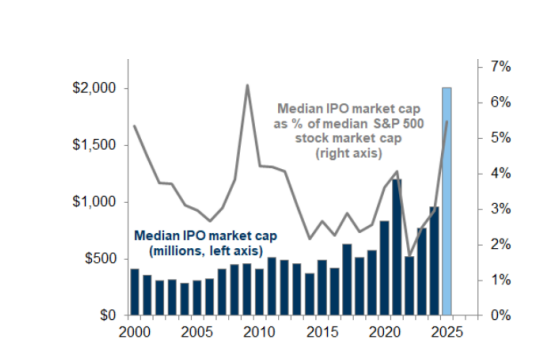
Smaller language models will likely drive AI’s near-term growth by delivering more effective results in niche sectors. Private and traditional venture capital will fuel this growth (see Figures 7 and 8.) Nearly 60% of VC investments now exceed $500 million, up from 18% at the 2021 peak. The IPO market shows modest recovery, and large private and VC investments could push IPOs above past averages if this revival continues (see Figure 9.)
Figure 7
Privately Held Technology Companies Valued over $1 billion By Select Country/Region
Sources: CB Insights, Andrew Barnet/WSJ
Figure 8
Share of U.S. VC Investments in AI Companies
Source: Silicon Valley Bank
Figure 9
Median Annual Market Cap of U.S. IPOs
Sources: Goldman Sachs Global Investment Research, Dealogic
Immigration Limits and Low Churn Cloud Job Growth
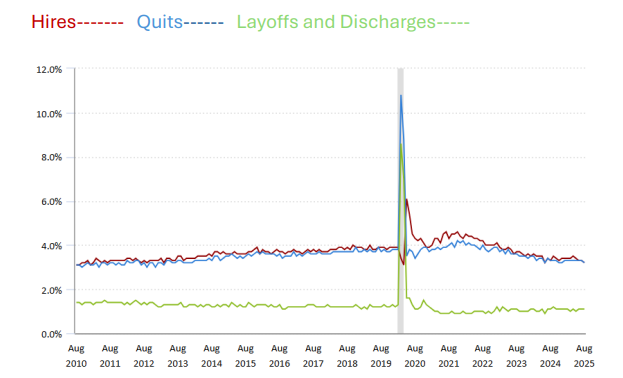
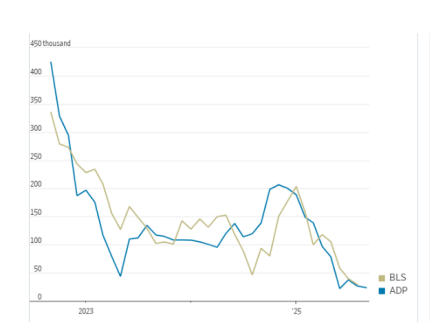
While AI spending surged, net immigration plunged 80% since late 2024, reducing labor supply growth. The American Enterprise Institute estimated this drop lowers “breakeven” payroll growth to 40,000-70,000 from 100,000-125,000. Uncertain trade policies lead businesses to freeze hirings and layoffs, reducing labor market churn (see Figure 10.) While the federal government shutdown blocked release of September BLS jobs data, ADP showed weakening third quarter private employment (see Figure 11.) The Fed faces a weakening labor outlook, driven partly by immigration constraints which clouds job growth.
Figure 10
Total Nonfarm Hires, Quits, and Layoffs and Discharges
(seasonally adjusted)
Source: U.S. Bureau of Labor Statistics
Figure 11
Private-Sector Job Growth—Three Month Average
Sources: Labor Department, Automatic Data Processing, @NickTimiraos
Investment Conclusions—Strong Financial Markets Support Higher
Consumer Spending: Despite a government shutdown resembling Washington’s Hatfields-versus-McCoys feud, hyperscale data center investment surged, rewarding companies feeding on these billion-dollar projects. At the same time, stagnant workforce growth will likely accelerate adoption of AI-powered automation and robotics. Strong financial markets underpin higher-income consumer spending, driving surprising economic growth in 2025.
Domestic Equities– Explore Beyond “Mag 7”– Narrow Markets Diversify Portfolios:
Investors should target sectors and companies–public and private—beyond the “Mag 7” to capitalize on AI’s expanding impact across industries. Elevated equity multiples and a narrow market favor diversified portfolios and indices. Prioritize quality firms that sustain above-average earnings growth, maintain strong balance sheets, and accelerate dividend payouts and share buybacks. Use precious metals and selected digital assets to enhance diversification amid rising global uncertainties.
Global Equities– U.S. Multinationals an Alternative—European Security-Defense
Indices: U.S. multinationals, generating significant foreign revenues, provide a conservative global investment option, especially when the U.S. dollar weakens. Escalating European security concerns from the war in Ukraine and diminished U.S. regional commitment suggest investors consider European defense stocks or related indices.
Fixed Income–Treasury Notes, Agency Paper, and Selectively Private Credit: As the gap between U.S. corporate and Treasury yields narrows to its smallest level since 1998 and reduces returns for assuming credit risk, focus on intermediate Treasury notes and Agency paper. Tight public-market spreads highlight selective opportunities in private credit, which provides access to growing U.S. industry segments unavailable in public markets and offers more attractive yields.
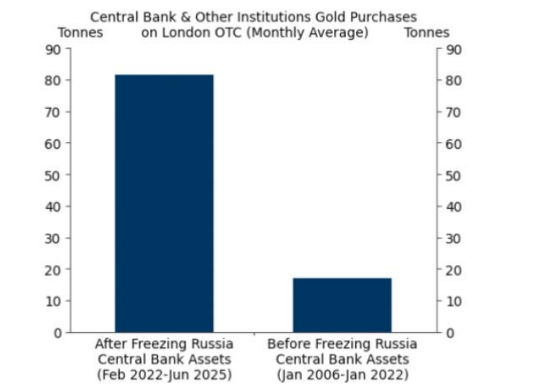
Gold Addendum: “Financialization of Warfare” Drives Central Bank Accumulation—Initial Driver of Rising Gold Prices: After Russia invaded Ukraine in February 2022, our March Commentary described how U.S. sanctions froze $315 billion of Russian bank reserves in western banks and initiated the “Financialization of Warfare.” The Commentary warned that such actions could push non-western countries to stop treating U.S. government debt as “risk free” and to substitute gold for dollar reserves. These 2022 observations projected the basis for central banks’ subsequent gold accumulation and the initial driver for rising gold prices now visible (see Figure 12.)
Figure 12
Central Bank Reserves Diversification into Gold
Sources: Goldman Sachs Investment Research, Haver Analytics, Bloomberg