


Fed’s Muddy’s Interest Rate Outlook—reflects Higher Neutral Rate–Highest Tariffs–U.S. Tax Revenue and Trade Loss—china Cannot Export Its Economic Challenges—china’s Defense Spending Equals U.S.—u.S. Prioritizing Defense Tech– Benefits Mid-Cap Defense Tech Stocks—reduced Immigration– Benefits Capital Equipment Stocks
Fed’s Muddy Interest Rate Outlook—Reflect Fed’s Concern over Administration’s Policies Impact on Inflation
As expected, the FOMC lowered the fed funds rate by 25 basis points to 4.25-4.50% while marginally raising its inflation outlook. Their statement signaled a pause and a higher threshold for future cuts. Recent core PCE Inflation data showed an improving monthly trend increasing the probability for a rate cut in the first quarter (see Figure 1). Our November Commentary highlighted that strong capital spending and “sticky” inflation could push the nominal neutral rate to 3.8%, aligning with FOMC’s December projections of two 25 bp cuts bringing the rate down to 3.75-4.00%. The Fed’s caution likely reflects uncertainty over the potential inflationary effects of President-elect Trump’s tariff and immigration policies.
Figure 1
Personal Consumption Expenditures (PCE) Inflation
(% Change Past Month)

Source: Federal Reserve Bank of Cleveland
Growing Budget Deficit—Result U.S. Negative Saving Rate— Need Foreign Savings for Domestic Investment — Tariffs will not Reduce Overall Trade Deficit
Trump’s 2016 presidential run focused on fair trade and mass immigration. Based on his first term actions and rhetoric, reducing trade imbalances with major partners still remains a priority (see Figure 2). Tariffs may serve as bargaining chips, but rising federal deficits limit their impact. These deficits reduce the U.S. national saving rate, increasing reliance on foreign savings—funded by U.S. imports– to support domestic investments (see Figure 3).Unless higher tariffs reshore manufacturing–unlikely–they will simply shift trade deficits to other low cost countries with sufficient infrastructure.
Figure 2
U.S. Trade Deficit, Largest Sources 2023

Source: Department of Commerce
Figure 3
Net Saving, Net Private Saving, Net Federal Government Saving (1990-2024)
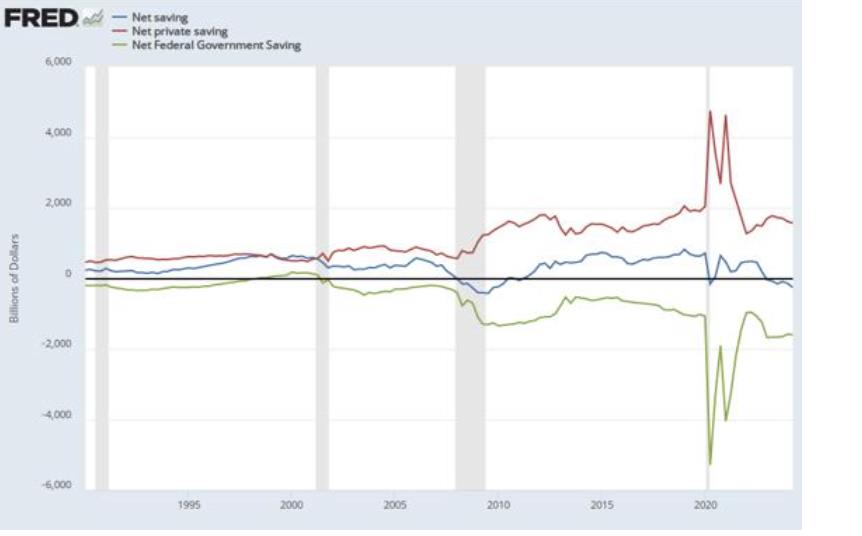
Sources: U.S. Bureau of Economic Analysis, Skyview Investment Advisors
China’s Entry into World Trade Organization– An Effort to Liberalize China–Failed—Instead Strengthened Chinese Communist Party’s One-Party Rule
In 2001, the U.S. sought to liberalize China by supporting its entry into the World Trade Organization (WTO). Instead, China exploited global markets to reinforce the CCP’s unchallenged, one-party rule adhering to Chairman Deng Xiaoping’s dictum to “hide our capacity and bide our time.” The failure to liberalize China spurred the initial push back from the U.S. and other nations.China Exporting Excess Production—Driven by low Domestic Consumption/Savings As China’s global ambitions grew, the first Trump administration imposed tariffs to curb its import share, a policy continued by the Biden administration. However, China’s export of excess production now poses a new threat to global trade. This overproduction stems from low domestic consumption driven by high consumer savings (See Figure 4). Weak demand also limits imports, worsening trade imbalances.
Figure 4
Household Consumption as a Share of GDP Across Major Development Periods, Selected Economies

Sources: World Development Bank, Rhodium Group
High Tariffs-Trade and Revenue Loss-China Cannot Export its Economic Challenges
A second Trump administration will likely escalate trade pressures, prompting potential Chinese retaliation, such as restricting critical minerals or reducing farm imports or access to drones and drone components. The Committee for a Responsible Federal Budget estimates that steep tariffs— such as a 60% rate—could lead to revenue losses due to reduced trade volumes (see Figure 6). However, China’s economic slowdown and risk of social unrest may weaken its stance. Ultimately, outcomes may prove milder than rhetoric suggests, as China may recognize it cannot export its economic challenges to the world.
Figure 5
U.S./China Tariff Scenarios and Net Impact on Tax Revenues

Sources: Committee for a Responsible Federal Budget, Congressional Budget Office, and U.S. Census Bureau
Mass Deportations Not Logistically Likely—4 Sectors Primarily Impacted by Deportations
The record 8 million immigrants arriving between 2021 and 2023, included an estimated 60% unauthorized. In response, President-elect Trump pledged mass deportations,however, logistical challenges make this unlikely. Figure 6 highlights potential impact on key sectors from removing unauthorized immigrants. The first Trump administration deported about 300,000 annually, compared to 400,000 under Obama. Immediate targets include1.3 million with final deportation orders and 863,000 under Temporary Protected Status (TPS). According to the American Immigration Council, scaling up deportations to one million unauthorized immigrants annually would cost $2.1 billion. Private prison companies, operating 90% of detention centers, would likely benefit from increased deportations and spending.
Figure 6
Impact of Unauthorized Immigrants on Key Sectors

Source: American Immigration Council
China Defense Spending Equals U.S.—U.S.to Boost Defense Tech Spending
Beyond trade conflicts, the U.S. faces a growing military rivalry with China. The FY24 U.S. defense budget topped $800 billion, 3-4 times China’s, based on exchange rates. However, the American Enterprise Institute (AEI) found that in 2022, Chinese defense spending matched the U.S. when adjusted for “military purchasing power parity” and for hidden expenses (see Figure 8). To address growing global threats, the U.S. plans to boost defense spending, prioritizing digital capabilities, AI and autonomous systems. Funding this increase poses a challenge, as rising budget deficits pushed interest expenses beyond defense spending.
Figure 8
Accounting for Economic Differences and Hidden Expenditures, China vs. U.S. Military Spending 2022

Source: American Enterprise Institute
Investment Conclusions
Domestic: As the Trump administration assumes office on January 20th, its campaign promises will face real-world challenges. Potential tariffs and a 15 percent income tax rate on U.S.-made products could incentivize companies to establish or expand their domestic facilities. However, the timing and implementation of these policies, especially tariffs, will hinge on political decisions beyond normal economic analysis. These uncertainties led to muddied Fed rate guidance. If “sticky inflation” comes unglued and accelerates, the Fed will face tough choices.
Global: Compared to Europe’s political instability—particularly France and Germany—the U.S.’s relative stability, tax incentives, and lower energy costs may attract businesses seeking to avoid tariffs. Outcomes will hinge on geopolitical dynamics and international responses to the administration’s new world view. Surprisingly, geopolitical shifts may resolve conflicts in Ukraine and the Middle East, spurring reconstruction investments and easing inflationary pressures. Meanwhile, the return of the MAGA President will likely give Wall Street elites ample rhetoric to attempt to understand and analyze.
Equities:
Productivity Enhancers: Slowing work force growth and reduced immigration will likely drive investments in systems and equipment to increase productivity and reduce labor reliance. Renewing immediate expensing of equipment purchases for tax purposes would further support this demand.
Mid-Cap: Delayed rate cuts challenge mid-cap stocks, with roughly 50% of their debt at floating rates. However, as disappointment fades, quality mid-cap stocks should benefit from growing demand for their productivity-enhancing products and services, leading to their recovery and higher earnings.
Defense Tech: The Defense Department’s focus on digital technology, AI and autonomous weapons should attract investors interest in smaller, non-traditional defense tech stocks. For most investors, specialized defense tech ETF’s may offer the best approach.
Stronger Dollar: The Fed’s higher-for-longer rate policy may strengthen the dollar, adversely effecting U.S. global companies when converting foreign earnings.
Fixed Income: With the Fed standing back on rate cuts and with bond market spreads tight, investors should focus primarily on Treasury Notes with two-four year duration.
Alternatives: Amidst changes in the financial industry and markets, alternatives provide investors the opportunity to engage in these changes by investing in the growing use of private credit. Additionally, alternatives also provide diversification benefits by being less correlated with stocks and bonds.