


Consumers Continue to Open Their Wallets— Services Sector Wage Growth Underlies “sticky” Inflation—could Drive Terminal Funds Rate Higher—corporate Tax Stability and Election Conclusion Encourages Business Investments— Growing Budget Deficits May Lead to New Tax Sources–Eased Regulatory Burden Benefits Small and Mid-Cap Equity Outlook—could Revitalize Ipo Markets
U.S. Consumers Continue to Open Their Wallets
Despite the “tumultuous” presidential campaign, American consumers continue to show strong spending. Core retail sales increased 3.5% for the first ten months of the year.Rising incomes, revised and increased consumer saving, combined with growing net worth suggest consumers will likely continue to open their wallets during the holiday season (see Figures 1 and 2). Consumer sentiment, measured by the University of Michigan survey, reached its highest level since April (see Figure 5). Declining gasoline prices and postelection relative stability may bolster this trend. Reflecting these positives, the Atlanta Fed’s GDPNow projects 2.5% fourth quarter growth, with the potential for further upside.
Figure 1
Revised Consumers Saving Rate
(Percent)
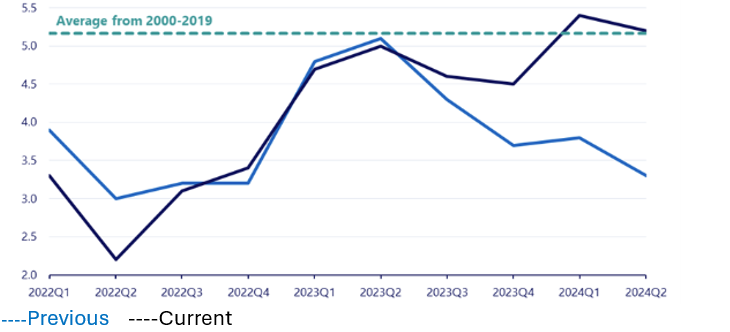
Source: BofA Global Research
Figure 2
Household Net Worth
(% of Disposable Income))

Source: Financial Accounts of the United States vis Haver Analytics
Figure 3
University of Michigan Consumer Sentiment Monthly Index

Sources: University of Michigan, The Real Economy Blog
Persistent Sticky Inflation—Services Sector 40% of Core Inflation–Services Wage Growth Near 5%
If U.S. economic growth continues to exceed its projected 2% long-term real growth rate, inflation could remain above the Fed’s 2 percent target. According to the Cleveland Fed, the median CPI inflation rate helps gauge underlying inflation trends. Recent flat monthly median CPI readings point to persistent, ”sticky” inflation (see Figures 4 and 5). Wage growth of 5% in the services sector—which comprises 40% of the CPI— further raises concerns over persistent CPI inflation (see Figure 6). Additionally, potential new tariffs from the Trump administration, potentially implemented as assertively as its cabinet appointments, could produce one-time inflationary pressures.
Figure 4
Median CPI Inflation % Change Past Month

Sources: Bureau of Labor Statistics, Federal Reserve Bank of Cleveland
Figure 5
Core Sticky-Price CPI Inflation—3 Month Annualized

Source: Federal Reserve Bank of Atlanta
Figure 6
Wage Growth Tracker—Services
(3-month moving average of median wage growth, hourly)

Sources: Current Population Survey, Bureau of Labor Statistics, Atlanta Federal Reserve
Strong Growth—Persistent Inflation—Could Drive Terminal Rate Higher
Strong growth, fueled by capital spending and potentially persistent inflation, could
increase the neutral rate leading to a higher terminal fed funds rate. In a recent speech, Dallas Fed President Lorie Logan estimated the neutral real interest rate could range from 0.74 percent to 2.60 percent. Using the mid-point of this range and adding the Fed’s 2 percent inflation target yields an approximate neutral fed funds rate of 3.8%. The neutral rate uncertainty shows up in the wide range of September fed funds rate projections from FOMC members (see Figure 7). This analysis suggests the Fed may slow its pace of rate cuts, with the terminal rate likely exceeding the median funds rate projected in September.
Figure 7
FOMC Participants Target Level for the Federal Funds Rate

Source: Federal Reserve Board
Republican Victory—Tax Stability and Election Conclusion—Encourages Business Expansion
The Republican election victory signals that the 2017 Tax Cuts and Jobs Act (TCIA) will likely be renewed, maintaining personal tax rates and adding roughly $5 trillion to the deficit over the next decade. Since the 2017 TCIA set the corporate tax permanently at 21 percent, the election outcome enhances the likelihood of renewing 100 percent expensing for capital investments (see Figure 8). With the election now concluded, this tax stability may
encourage further business expansion, adding to the $200 billion in investments for data centers. However, the growing budget deficit may impact Congress’s commitment to President-elect Trump’s proposal to lower the corporate tax to 15 percent on American- made products.
Figure 8
The Decline of Effective Corporate Tax Rates

Source: CompStat data
Cutting Federal Spending—Not Sufficient to Reduce Deficit—New Forms of Taxes May Be Needed
President-Elect Trump announced the creation of the Department of Government Efficiency (DOGE) to cut Federal spending by $2 trillion– nearly a third of the FY 2025 budget. This will be challenging as about a third of the budget will be spent on entitlement programs like Social Security, 15 percent each allocated to interest and defense. The remaining 40 percent of the budget, funds programs such as Medicaid and Veterans benefits, politically difficult to cut. In terms of tax revenues, over half come from personal income taxes, but even a 50 percent rate increase would yield only $900 billion, less than half the annual federal deficit. Therefore, a new value-added tax (VAT) may ultimately be considered. The Congressional Budget Office estimated a broad 5 percent VAT could
generate $3 trillion over a decade (see Figure 9).
Figure 9
Impose a 5 percent Value-Added Tax

Source: Staff of the Joint Committee on Taxation
Eased Regulatory Burden—Repeal of Chevron Doctrine—Benefits Small and Mid-Sized Companies
The second Trump Administration will likely ease regulatory burdens on businesses. This will particularly benefit small and medium sized companies that often struggle adapting to new regulations due to their limited resources. Additionally, the Supreme Court’s recent
repeal of the Chevron doctrine further limits federal agencies power to interpret applicable statues. By removing judicial deference to the federal agencies’ interpretation of ambiguous statutes, the decision returns that responsibility back to the judicial system. Absent Chevron, federal agencies will likely scale back regulations across various sectors, further reducing the regulatory load on businesses.
Investment Conclusions
As the Trump administration assumes office on January 20th, its campaign promises will soon face real-world challenges. Proposed tariffs and a potential15 percent tax rate on U.S.-made products may encourage both domestic and international corporations to establish new facilities in this country. The relatively stable U.S. political environment,
when contrasted with that of Europe’s two largest economies–France and Germany–could also prompt businesses from these countries to expand operations in the U.S. to gain from tax incentives, avoid higher tariffs, and access lower energy costs. However, these
potential outcomes will depend on global geopolitical uncertainties and how other nations respond to the administration’s new world view.
Equities: These changes, along with a likely reduction in regulatory and legal constraints and lower short-term rates should further benefit high quality small and mid-cap
companies as well as the equal-weighted SCP 500 index. If the dollar remains strong, then international markets may become less appealing. Additionally, easing S.E.C. regulations and improving small and mid-cap equity performance may revitalize IPO markets.
Fixed Income: With the Fed implementing a series of rate cuts and bond market spreads tight, investors should focus primarily on Treasury Notes with a duration of two-four years.
Alternatives: Amidst changes in the financial industry and markets, alternatives provide investors the opportunity to engage in these changes by investing in the growing use of private credit. Additionally, alternatives also provide diversification benefits by being less correlated with stocks and bonds.