


“Forever” Primary Deficit Boosting Higher Term Premium —Long-Term Rates–Lower Budget Deficit Not Higher TariffsReduces Trade Deficit—Growing Business Uncertainties–Accelerating Earnings Growth Not Multiple Expansion Key toEquity Performance—2-4 Year Duration for Fixed Income
Rising Inflation Expectations—Higher January Inflation Repeat of 2023/24 Januarys—Subsequent Readings Key to Inflation Outlook
Tariff headlines may contribute to the surge in one-and ten-year inflation expectations reported in the University of Michigan Survey of Consumer Attitudes (see Figure 1).Anchoring inflation expectations will prove critical for effective monetary policy. These readings occurred prior to the strong January CPI figures. Based on trends from the past two years, January’s CPI index may reflect annual price increases at the year’s start (see Figure 2). Subsequent readings in the coming months should clarify this impact.
Figure 1
University of Michigan One-Year Inflation Expectations
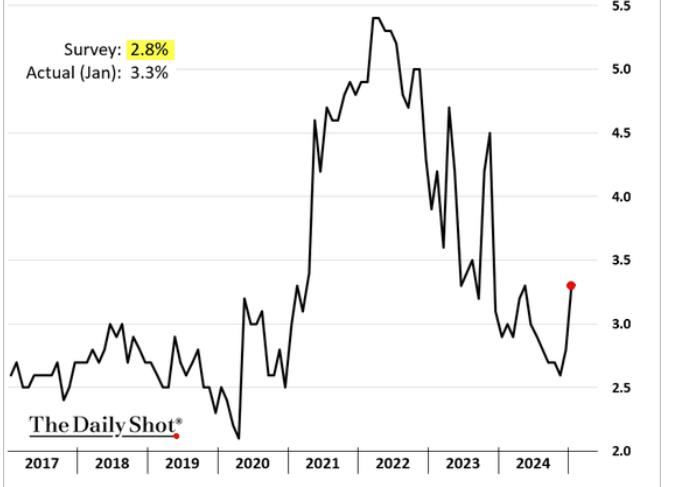
University of Michigan 5-10-Year Inflation Expectations

Sources: The Daily Shot, University of Michigan Consumer Sentiment
Figure 2
Inflation* Rises During the Start of the Past 2 Years
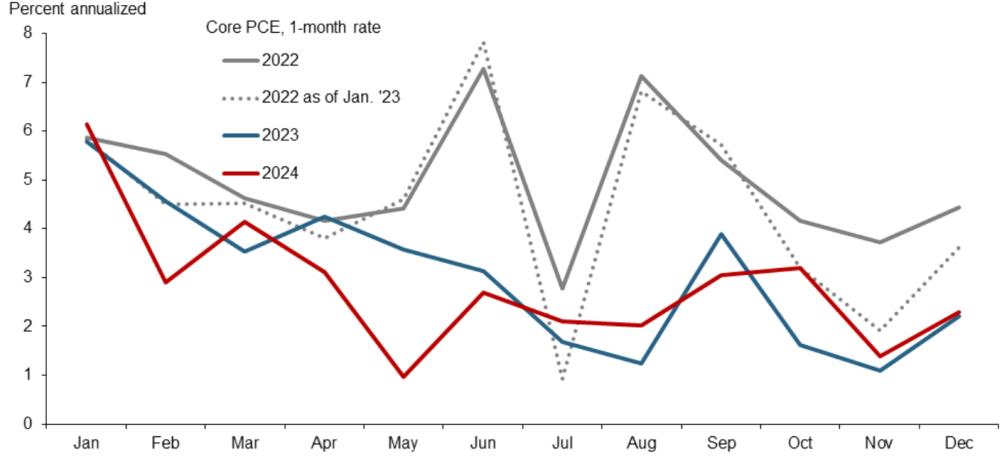
*Note: PCE is personal consumption expenditures
Sources: Bureau of Economic Analysis, Federal Reserve Bank of Dallas
“Forever” Primary Deficit Boosting Higher Term Premium—Long-Term Rates
U.S. long-term rates surprised investors by not falling after the last Fed rate cut. This may reflect a higher term premium compensating for sticky inflation and a federal budget primary deficit with no end in sight, coupled with interest outlays exceeding the primary deficit (see Figure 3). Historically, the government bolstered fixed-income investors’ confidence by periodically producing small primary surpluses to reduce debt levels (see Figure 4). Ongoing primary deficits and inflation above the Fed’s target will likely contribute to higher term premiums and reduced long-term rate responsiveness to Fed rate cuts.
Figure 3
Total Deficit, Net Interest, Net Interest Outlays, and Primary Deficit
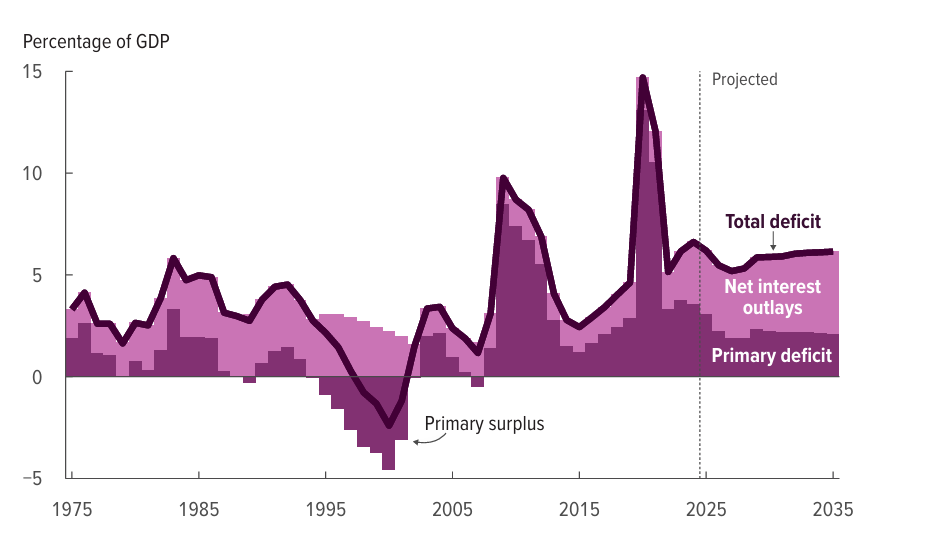
Source: Congressional Budget Office
Figure 4
Ratio of Primary Surplus to Outstanding Public Federal Debt
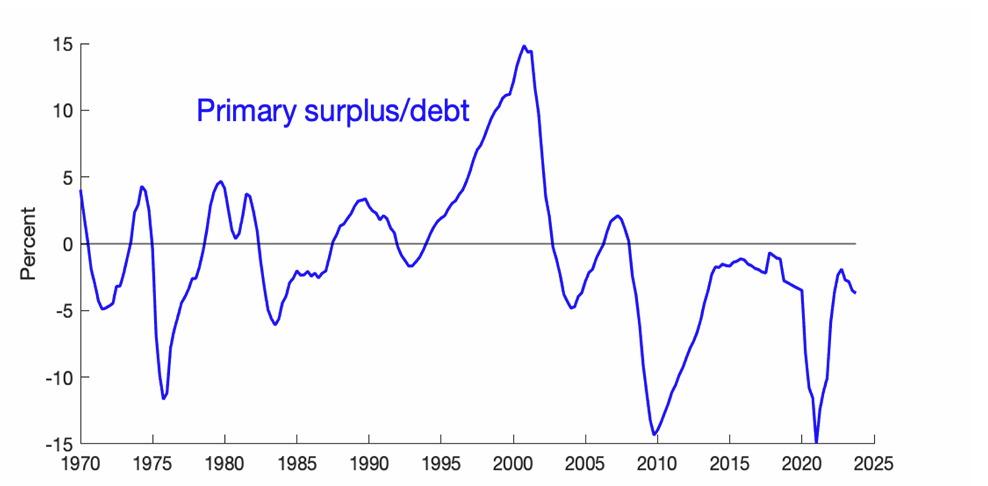
Source: Monetary-Fiscal Interactions John H. Cochrane
Generative AI Productivity Boost Could Stimulate Economic Growth and Reduce Budget Deficit Burden on the Economy—Lower Long-Term Rates
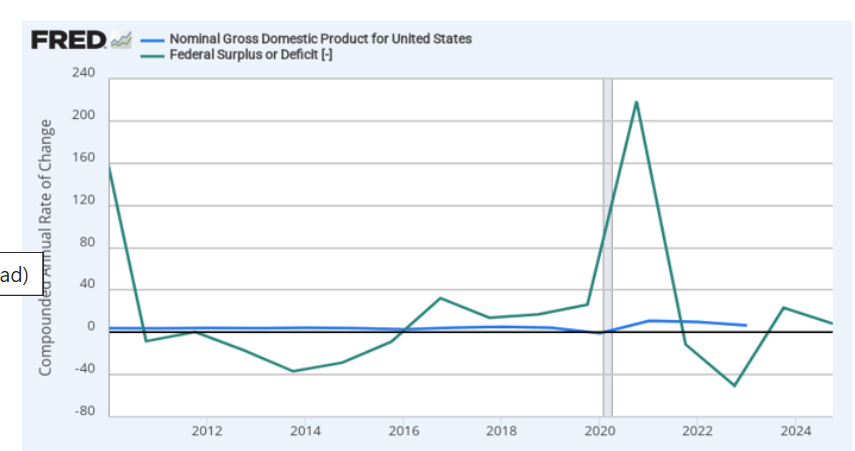
Reducing the deficit’s burden on the economy will require nominal GDP to outpace the deficit’s growth of roughly 4 percent (see Figure 5). Nominal GDP Growth arises from a combination of inflation and labor productivity, which annualized at 1.2 percent last year. Assuming inflation around 2 percent, nominal GDP growth could exceed deficit growth if productivity reaches 2-3 percent. Accelerating changes from generative-AI adoption may make this achievable by decade’s end, if not sooner. Goldman Sachs estimates a 1.5% annual productivity gain from AI adoption over the next ten years. Additionally, DeepSeek’s breakthrough in competitive compute pricing underscores the history of rapid price declines as new technologies develop. The synergy of generative AI and falling costs will enable companies to increase productivity by automating tasks thus increasing economic growth and potentially alleviating the deficit’s burden. Lower long-term interest rates could result.
Figure 5
Annual Growth—Nominal GDP and Federal Deficit—2000-2024
Sources: U.S. Office of Management and Budget, Skyview Investment Advisors
Growing Budget Deficit—Result U.S. Negative Saving Rate— Need Foreign Savings for Domestic Investment — Tariffs will not Reduce Overall Trade Deficit
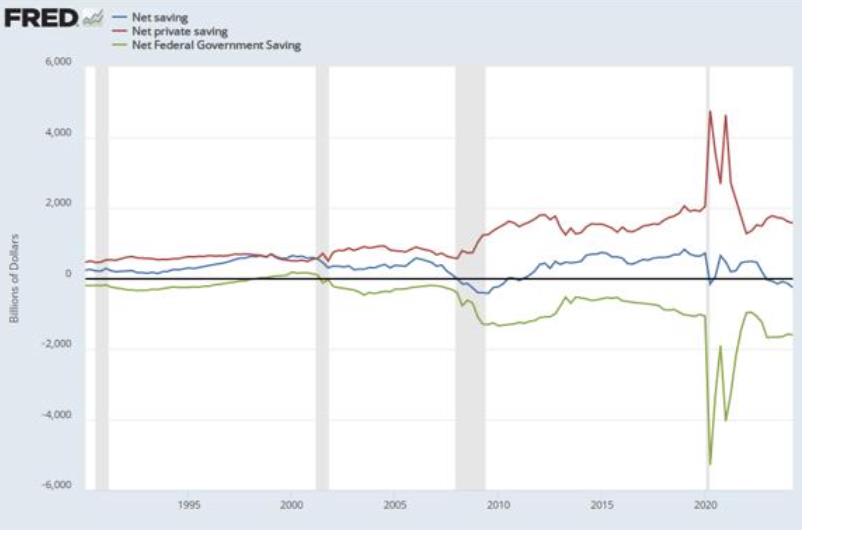
The Administration’s expanded use of tariffs, along with frequent policy changes, create confusion for investors and uncertainty for long-term capital spending. This confusion may stem from the shift to using tariffs as sanctions rather than restricting countries’ access to the global banking system. While tariffs can serve as bargaining chips, rising federal budget deficits limit their effectiveness, leading to a negative U.S. national saving rate and increased reliance on foreign savings—funded by U.S. imports–to support domestic investments (see Figure 6). With savings lower than investments, the U.S. will run a trade deficit regardless of how high the tariffs. Frequent changes in tariff announcements, primarily aimed at addressing the trade deficit, will likely dampen the global economic and trade outlooks.
Figure 6
Net Saving, Net Private Saving, Net Federal Government Saving (1990-2024)
Sources: U.S. Bureau of Economic Analysis, Skyview Investment Advisors
Investment Conclusions
The power of one person to wield American economic and military power can shock many observers. Investors struggle to react to rapidly changing policies and off-the-cuff remarks that carry significant economic and geopolitical implications. Surprisingly, both economists and investors seem comfortable with a generally favorable economic outlook despite major unknown policy changes. Many economists may not fully incorporate these uncertainties, leading investors to overlook potential market volatility from the administration’s regulatory and tariff policy announcements. Given such uncertainties, to quote the firms late advisor, the Nobel Prize winner Harry Markowitz, “the only free lunch in investing is diversification.” For investors sharing these concerns, adjusting their portfolio weightings may be prudent.
Equities: The likelihood of sustained higher long-term rates and the overall business uncertainty suggests that accelerating earnings growth, rather than multiple expansion, will be key to equity performance this year.
Productivity Enhancers: Generative AI will undoubtedly enhance productivity. While we may not understand the “laws” of generative AI, the fundamentals of economics remain clear. As new and existing generative AI services reduce access prices, investors should look beyond the Mag7 to identify companies that can leverage these lower service costs to develop specialized services using their proprietary data bases. Additionally, with the substantial capital investment in hyperscale data centers by the Mag 7, investors should also explore “picks and shovel” companies that will benefit from increased infrastructure spending.
Defense Tech: From our last Commentary (1/20/2024), the Defense Department’s focus on digital technology, AI applications, and autonomous weapons should attract investors interest in smaller, non-traditional defense tech stocks. For most investors, specialized defense tech and cyber security ETF’s may offer the best approach.
Stronger Dollar: The Fed’s higher-for-longer rate policy may strengthen the dollar, adversely affecting U.S. global companies when converting foreign earnings and the performance of non-U.S. markets to U.S. dollars.
Fixed Income: With rates likely to remain high with narrow spreads in the fixed income markets, investors should focus primarily on Treasury Notes with two-four year duration in the public markets as well as opportunities in the private credit markets.
Alternatives: Amidst changes in the financial industry and markets, alternatives provide investors the opportunity to engage in these changes by investing in the growing use of private credit. Additionally, alternatives also provide diversification benefits by being less correlated with stocks and bonds.