


MARKETS LEAD THE FED–FED LEARNED FROM THE PAST–MAKE MAJOR RATE CUTS NOW–NO SIGNS POINT TO IMMINENT SLOWDOWN–LARGE SCALE DEFENSE PROCUREMENT COULD SPUR VC BACK AI DEVELOPMENT–FOCUS ON QUALITY MID/SMALL CAP COMPANIES
Markets Lead the Fed
The Fed aggressively cut the funds rate by 50 bps to 4.75-5 percent with at least another 50 bps likely by year-end. Capital markets already anticipated the Fed’s actions (see figure 1). Instead of financial markets “fighting the Fed,” the Fed now seems to follow the markets lead. By acting now, the Fed aims to avoid criticism it faced for its previous delayed response to rising inflation. As the Fed works to “normalize” the yield curve, the terminal funds rate will likely settle around 3 percent by 2026.
Figure 1
Capital Market Rates

Sources: BofA Merrill Lynch & Board of Governors via Haver Analytics, Richmond Fed
No Excesses in the “Real” Economy–Imminent Slowdown Unlikely
Despite restrictive monetary policies, third quarter growth will likely exceed the 2 percent long-term average (see Figure 2). Liquidity generated by rising equity markets and narrow bond spreads raises doubt about how restrictive these policies truly can be. While recessions often will be triggered by excesses, such as overstocked inventories or real estate bubbles, no major imbalances currently exist in the “real” economy. However, growing “finalization” of the U.S. economy could produce excesses in the financial markets, particularly in credit, which could spill over into the “real” economy, leading to a slowdown or even a recession.
Figure 1
Atlanta Fed GDPNow real GDP estimate for 2024 Quarter 3
(Quarterly % Change SAAR)

Sources: Blue Chip Economic Indicators and Financial Forecasts, Federal Reserve of Atlanta
Inventory Buildup for Holiday Season due to Potential Long-Shoreman’s Strike—Higher-Income Consumers Key to Clearing the Holiday Inventory Buildup
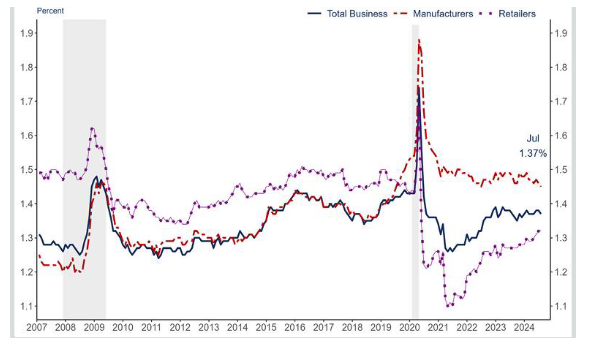
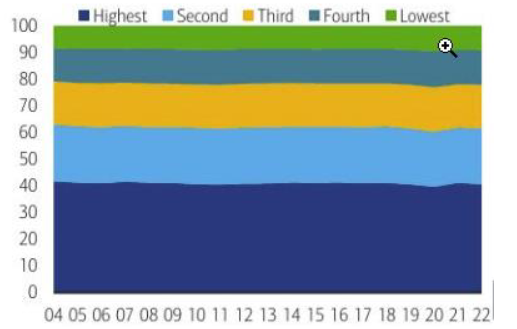
The fourth quarter GDP outlook, will depend, as it usually does, on holiday consumer spending. However, uncertainty arises from the early buildup of retail inventories due to the threatened East Coast strike by the International Longshoremen’s Association on October 1 (see Figure 3). Higher price levels on essentials and higher interest costs for housing and autos puts a squeeze on low-and-middle income consumers likely limiting their holiday spending. Clearing out retail inventories will therefore rely heavily on higher-income consumers, who account for 60 percent of personal consumption (see Figure 4). Willingness to open their wallets may also be influenced by equity market performance and the associated net wealth effect.
Figure 3
Business Inventory/Sales Ratio
Sources: Census Bureau vis Haver Analytics, Federal Reserve Bank of Richmond
Figure 4
Share of Consumption by Income Quintile–Percent—(2004-2022)
Sources: Federal Reserve Board, BofA Global Research
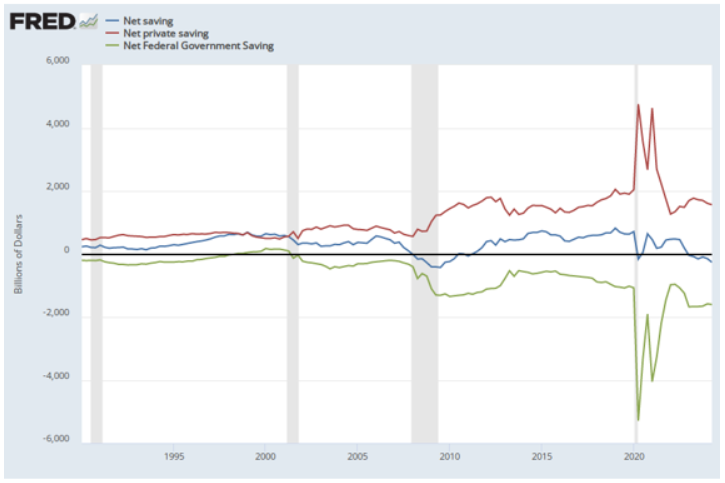
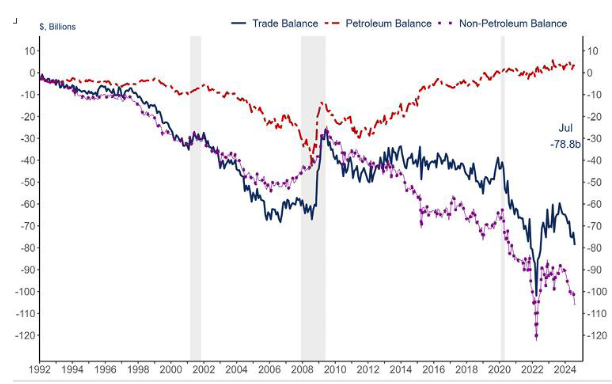
Growing Budget Deficits Minimize Impact of Tariffs in Reducing Trade Deficits The effectiveness of higher tariffs in reducing trade deficits seems doubtful given the rising budget deficit. Funding U.S. investment growth requires a positive national savings rate combining private, corporate, and government savings. However, the budget deficit exceeds combined private and corporate savings, resulting in a negative U.S. net saving rate (see Figure 5). This forces reliance on foreign savings, generated by exports to the U.S., to fund U.S. investments. Consequently, trade deficits will likely continue to grow alongside a rising budget deficit to meet U.S. investment funding needs (see Figure 6).
Figure 5
Net Saving, Net Private Saving, Net Federal Government Saving
(1990-2024)
Source: U.S. Bureau of Economic Analysis, Skyview Investment Advisors
Figure 6
Balance of International Trade-Continues to Grow Despite Higher Tariffs
Sources: Census Bureau via Haver Analytics, Richmond Fed
Large Scale Defense Tech Procurement Using Venture Backed Defense Contractors Could Spur AI Development
The U.S. faces its most challenging adversarial environment since World War II. Yet,defense spending declined as a share of GDP, while interest payments on the deficit now exceed defense spending (see Figure 7). A recent report from the Commission on the National Defense Strategy study found the U.S. military lacks the capabilities to confidently deter and prevail in combat and must scale new technologies. The Center for Strategic &International Studies(CSIS) noted a recent shift towards large-scale tech procurement. The Air Force, for instance, focused on developing AI-enabled, autonomous weapons like the Collaborative Combat Aircraft Program (see Figure 8). By separating capital-intense hardware procurement from less costly software, and partnering with venture-backed defense contractors, initiatives, like this, could spur AI advancements with potential commercial spillovers, similar to the internet’s evolution. It would also counter innovative military developments by potential adversaries.
Figure 7
Defense Department Budget Authority FY1952-FY2029 (% of GDP)
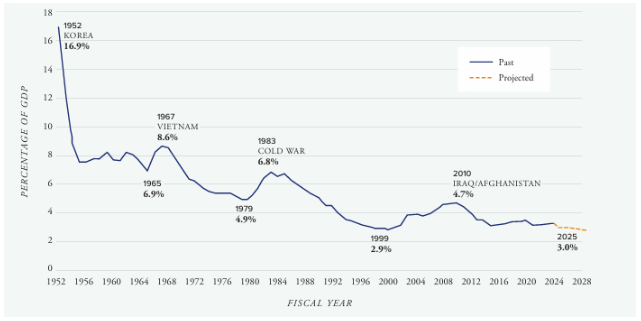
Source: Commission on the National Defense Strategy
Figure 8
DOD Spending on Selected Autonomous Aircraft Programs (FY 2015-29)
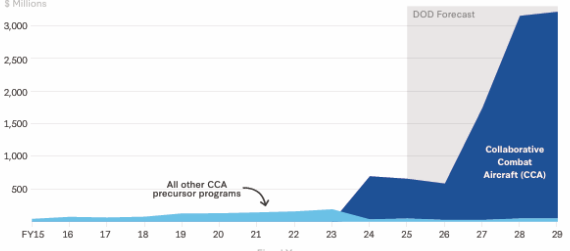
Source: CSIS analysis
Investment Conclusions
The Fed’s rate cut marks an inflection point in monetary policy, signaling the start of yield curve “normalization” (see Figure 9). Meanwhile, financial markets and the broader economy face several “known unknowns,” including the U.S. national election outcome, which will shape fiscal policy and renewed tax legislation. Escalating conflicts in the Middle East and Eastern Europe also pose risks to global markets, particularly to commodities and energy. These uncertainties highlight the need for portfolio diversity as well as quality individual investments.
Figure 9
U.S. 10yr-2yr Government Bond Spread (bps)
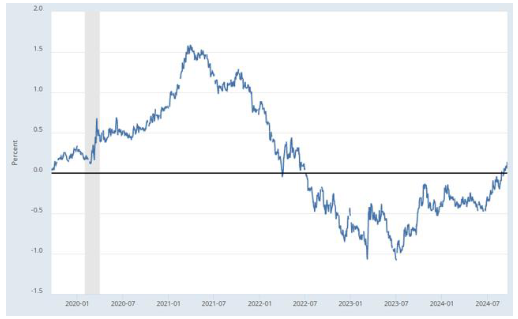
Source: Federal Reserve Bank of St. Louis
Equities: Lower U.S. interest rates could weaken the U.S. dollar longer-term benefitting U.S. global companies with significant non-U.S. business as well as equities listed outside the United States. A softer U.S. dollar would also boost commodities and commodity-producing companies. Multiple rate cuts would especially help mid and small-cap companies reliant on floating rate debt. Historically, market leadership shifts to these companies following Fed rate cuts. Quality becomes a key as 40 percent of Russell 2000 companies operate at a loss, compared to nearly 80 percent of S&P Small Cap 600 and S&P 400 mid-cap Index firms showing profits. This shift would also benefit the equal- weighted S&P 500 Index. Finally, financials should benefit if the yield curve steepens.
Fixed Income: With the Fed now implementing a series of rate cuts and bond market spreads tight, investors should focus primarily on Treasury Notes and Bonds for their attractive yields and extend duration up to five years.
Alternatives: Amidst changes in the financial industry and markets, alternatives provideinvestors the opportunity to engage in these changes by investing in the growing use of private credit. Additionally, alternatives also provide diversification benefits by being less correlated with stocks and bonds.