


Fed Says Go—Depending—Fed Data Dependent—Data Not Reliable—Economy Normalizing—Higher Gold Prices Reflect “Financialization of Warfare”—Lower Interest Rates Could Weaken U.S. Dollar—Benefits U.S. Global Corporations
Fed Ready to Lower Funds Rate—Depending—September 6th Employment Report Key
The Fed will likely lower its funds rate at its September 17th/18th meeting following Chair Powell’s Jackson Hole remarks, “The time has come for policy to adjust…the timing and pace of rate cuts will depend on incoming data…..” The size of the cut could range from 25 bps or deeper with futures markets favoring a 25 bps cut (see Figure 1). The September 6th employment report, which should provide a clearer view of labor market trends compared to the quirky August employment report, will heavily influence the decision. With inflation moderating and economic uncertainty increasing, the Fed may prioritize avoiding further labor market weakness rather than fighting already moderating inflation.
Figure 1
Fed Funds Futures

Source: CME Group via Bloomberg
U.S Economy Entering Normalization Phase—Slower Growth
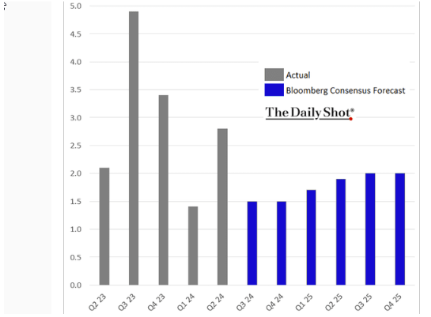
The U.S. economy seems to be entering a phase of normalization post the pandemic period. The labor market shows signs of a more typical relationship between the number of unemployed individuals and available job openings (see Figure 2). Inflation appears to be trending towards the Fed’s two percent target, while economists debate the likelihood of a soft versus hard landing. In the Bloomberg survey, economists give a 30 percent probability of a recession within the next twelve months. However, the prevailing economic view favors slower growth over the next two quarters followed by an economic rebound
(see Figure 3).
Figure 2
Number of Unemployed Persons per Job Opening

Source: Bureau of Labor Statistics
Figure 3
U.S. Real GDP Quarterly Projections (Q/Q% SAAR)
Sources: Bloomberg, The Daily Shot
Lower Income Consumers Squeezed by Higher Price Levels on Essentials The growing concerns about a potential economic slowdown may partially reflect the squeeze that elevated price levels put on lower income consumers. This squeeze results in Americans spending over 11% of their disposable income on groceries, the highest level in
three decades, disproportionately impacting lower income consumers (see Figure 4). Larry Summers and colleagues highlighted a “disconnect between the measures favored by economists and the effective costs borne by consumers,” particularly higher interest costs for financing housing and autos.
Figure 4
Food Spending and Share of Income Spent on Food Across U.S. Households—2022

Sources: USDA, Economic Research Service
Higher Income Consumers Key to Fourth Quarter Holiday Season Spending—Stock Market Performance will Influence Their Spending
At the higher end of the income spectrum, the top 20 percent of earners account for roughly 40 percent of personal consumption and all of net national savings (see Figures 5 and 6). Thus a spending pullback by upper-income consumers will more likely trigger an economic slowdown than a reduction in lower income spending. With the holiday season approaching, spending by the top income quintiles, responsible for 60 percent of personal consumption, will be crucial. One key variable influencing their willingness to open their wallets may be equity market performance and the resulting net wealth effect. In 2010, then Fed Chair Bernanke highlighted this connection in an Op-ed, Aiding the Economy:
What the Fed Did And Why, which noted higher stock prices can increase the wealth effect and spur spending.
Figure 5
Share of Consumption by Income Quintile–Percent—(2004-2022)

Sources: Federal Reserve Board, BofA Global Research
Figure 6
Savings Rate and Cumulative National Savings by Income

Income Quintile
Source: SOM Macro Strategies, The Daily Shot
Increased Immigration Distorts Unemployment Rate—Lower When Adjusted for Immigration
The latest nonfarm payroll increase missed consensus, with the unemployment rate increasing due to quirks in the report, raising doubts about the headline figures. For example, workforce growth from immigration, rather than long-term job losses, likely contributed to the higher unemployment rate. MRB Partners research suggests that adjusting for higher immigration leads to a lower estimated unemployment rate (see Figure 7). Additionally, the Bureau of Labor Statistics preliminary annual benchmark revision cut nonfarm payroll jobs by 818,000 to 2.082 for the 12 months ending March 24. The revisions also suggest the Household Survey understates employment growth compared to the CES payroll growth.
Figure 7
Immigration-Adjusted Unemployment Rate

Source: MRB Partners, The Daily Shot
Fed Data Dependent—Data not Dependable
Given the Fed’s data dependent approach, the reliability of that crucial data may be in question. For example, the response rate for the Current Employment Statistics Survey (CES) dropped from 60% in January 2020, at the beginning of the pandemic, to about 44% recently (see Figure 8). Due to the unclear July employment results, investors eagerly await the August jobs report on September 6th for a clearer picture of job market trends.
Additionally, August claims data indicate a stronger labor market compared to July.
Figure 8
Establishment Surveys Unit Response Rates, April 2014-April 2024

Source: U.S. Bureau of Labor Statistics
Growth of Fed Balance Sheet equal to One-Quarter of the U.S. Economy—”Financialization of Economy” Makes Fed Rate Decisions Even More Critical
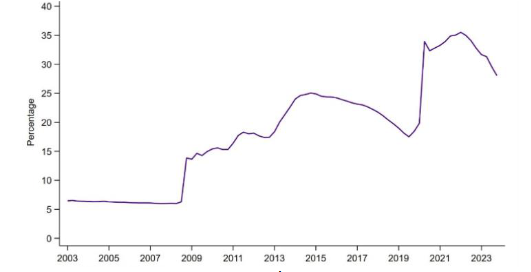
As the central bank of the United States, the Fed always played a crucial role in the economy and financial markets. However, after the 2008 Great Financial Crisis, the Fed’s influence grew significantly as it substantially increased the size of its balance sheet. The Fed’s total assets shot up from 6 percent of GDP in 2008 to 25 percent of GDP today (see Figure 9). This increase, with its balance sheet equal to one-quarter of the U.S. economy, underscores the heightened influence of financial markets on the “real” economy, often referred to as the “financialization of the U.S. economy.” This makes Fed policy decisions even more critical such as the likely upcoming funds rate cuts.
Figure 9
Total Federal Reserve Assets as a Percent of GDP (2003-2024)
Source: Federal Reserve, St. Louis Federal Reserve Data
“Financialization of Warfare” Drives Gold Prices
The strength of U.S financial markets and the dollar as the major reserve currency enables the U.S. to leverage those strengths in its global security strategies. In our Commentary (4/28/2022), we described the U.S. response to the Russian invasion of Ukraine as the “financialization of warfare.” The U.S. and other developed countries froze roughly $315 billion of Russia’s $640 billion of reserves. Our Commentary concluded that “it could lead to broader interest in substituting cryptocurrencies as well as gold for dollar transactions.” Since then, emerging market central banks increased their gold holdings to reduce their vulnerability to U.S. sanctions (see Figure 10), likely driving up gold prices.
Figure 10
Central Bank Gold Holdings

Sources: Bloomberg, @mikemcglone11
Investment Conclusions
Equities: Once the Fed begins cutting rates, it will likely follow with a series of similar cuts.
The resulting lower U.S. interest rates could weaken the U.S. dollar benefitting U.S. global companies with significant non-U.S. business as well as equities listed outside the United States. A softer U.S. dollar would also boost commodities and commodity-producing businesses. A series of rate cuts would particularly help companies reliant on floating rate debt. Historically, market leadership shifts towards small and midcap companies after a
Fed rate cut. With that rotation, quality becomes a priority with 40 percent of the companies in the Russell 2000 Index operating at a loss, while nearly 80 percent of S&P Small Cap 600 and S&P 400 mid-cap Index companies show a profit. Finally, financials should benefit if the yield curve steepens.
Fixed Income: With the Fed likely to implement a series of rate cuts, investors should consider primarily Treasury Notes and Core Fixed Income debt for their attractive yields and extend duration up to five years. The Federal Government’s inability to call Treasury paper provides added protection for investors in the event of a significant decline in interest rates.
Alternatives: Amidst changes in the financial industry and markets, alternatives provide investors the opportunity to engage in these changes by investing in the growing use of private credit. Additionally, alternatives also provide diversification benefits by being less correlated with stocks and bonds.