


FED PIVOTS–EQUITY MARKETS LIKELY BROADEN–FAVORS UNWEIGHTED STOCK INDEX–LOWERS INTEREST COST BURDEN ON SMID STOCKS–BOOSTS SMID STOCK PERFORMANCE AFTER PIVOT–MODERATELY EXTEND FIXED INCOME DURATION TO REDUCE REINVESTMENT RISK
The Earning Growth Gap Between Mega and Median Stocks Likely to Narrow over Next Two Years—Benefits Unweighted S&P 500 Index—Equity Risk Premium at Lowest Level in 20 Years-Benefits More Balanced Portfolios of Equities and Core Fixed Income– Higher Interest Burden on SMID Cap Stocks—Rate Cut Could Boost SMID Cap Stock Performance—Fed Pivot Moderately Extend Duration
Financial Markets Long for a Rate Cut—Equity Markets still Narrowly Built
Financial markets closely monitor the timing of the Fed’s anticipated first rate cut of 0.25%, while economists and strategists issue numerous reports on the topic. The futures market signals a 70 percent probability of two Fed rate cuts, with the first likely in September (See Figure 1.) We anticipate the initial cut may be postponed until December to avoid the appearance of electionyear interference. At the same time, the S&P 500’s recent strong rally can largely be attributed to a narrow group of stocks that account for nearly 30% of total market capitalization (see Figure 2.) The same disparity also shows up in the relative performance of the indices so far this year (see Figure 3.) As a result, roughly 60 percent of companies underperformed the S&P 500.
Figure 1
Fed Funds Futures

Sources: CME Group vis Bloomberg, Federal Reserve Bank of Richmond
Figure 2
Stock Market Concentration in the U.S.. 1950-2023

Sources: FactSet: Compustat, Securities and Exchange Commission, Annual Reports,
Morgan Stanley Research, The Daily Shot
Figure 3

Sources: YCharts, WOLFSTREET.com
Earning Growth Gap Between Mega and Median Stocks Likely to Narrow—Benefits Unweighted S&P 500 Index
Expected strong earnings results for a select group of stocks in 2024 helps drive their stock’s outperformance compared to the S&P 500 overall. Looking beyond this year, Goldman Sachs Global Research predicts the earnings growth gap between mega-cap stocks and the median S&P 500 Index stocks will likely narrow. This result would potentially lead to the unweighted S&P 500 index outperforming the weighted index.
Figure 4
Mega Cap Tech Stocks EPS Growth Narrows vs Median S&P 500

Sources: Goldman Sachs Investment Research as of 6/13/2024
Estimated Equity Risk Premium at Lowest level in 20 Years—Increases Attractiveness of more Balanced Portfolios of Equities and Core Fixed Income
The equity risk premium (ERP) represents the additional return investors seek to receive for investing in stocks instead of risk-free assets like Treasuries or core fixed income. Historically, equities outperformed core fixed income by more than 5% annually from 1922-2023, as calculated by comparing the compound annualized growth rates for both (See Figure 5.) More recently– 2010-2023—equities outperformed core fixed income by over 10%, reflecting higher compensation for bearing equity risk. However, recent trends such as increasing long-term bond yields and the rising S&P 500 decreased the estimated equity return premium to its lowest level in two decades (see Figure
6.) To counter this, investors may need to anticipate stronger earnings growth and consider more balanced portfolios of equities and fixed income for their attractiveness.
Figure 5
Equity Return Premium over Bonds
(Historical Equity Return Premium 12/31/1922—03/31/2024)

Sources: Bloomberg, Brown Advisory using S&P 500 Index for U.S. Large-Cap Equities and Bloomberg U.S. Aggregate Bond Index for Core Fixed Income
Figure 6
Implied Equity Risk Premium

Sources: MUFG securities
Higher Interest Burden on SMID Cap Stocks—Rate Cut Could Boost SMID Cap Stock Performance
Figure 7 illustrates the disproportionate burden of increasing interest costs on small and mid-cap stocks. Therefore, lowering the funds rate later this year could potentially boost small and midcap stock performance, potentially improving the significant underperformance of the SmallCap 600 Index (- 17.7%) and that of the MidCap 400 Index (-10.2%) compared to the S&P 500 Index increase of 15.1% as of 6/26/2024.
Figure 7
S&P Indexes Interest Coverage

Sources: Wisdom Tree, FactSet as of 5/31/2024
Fed Rate Pivot—Some Portion of $6 Trillion in Money Market Funds Flow into Equities and Fixed Income—Will the Equity Markets Broaden?
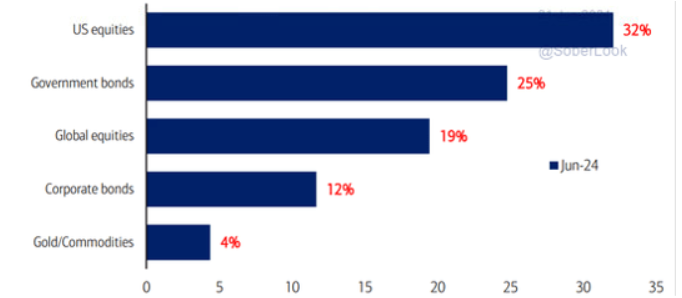
Once the Fed pivots on rates, some of the $6 trillion in money market funds will likely flow into equities and fixed income. The Bank of America Fund Manager Survey illustrates the potential for redistribution of these funds (see Figure 8.) The intriguing question arises as to whether the mix of equities will broaden from its current narrow scope when the funds shift away from the money market funds.
Figure 8
Money Market Fund Reallocation with Lower Interest Rates
Sources: BofA Global Fund Manager Survey
Investment Conclusions
Equities: If the Fed pivots later this year and the economy maintains its growth
, the narrowing earnings growth gap between “Mag” stocks and other companies may broaden the equity market beyond its current narrow leadership. One straightforward way to capitalize on this shift would be to utilize the equal-weight S&P 500 index.
Small Cap Equities: The S&P 600 offers one exposure to quality companiesbeyond the big-cap universe. Wisdom Tree’s table below illustrates key fundamentals for small cap stocks, emphasizing quality factors such as free cash flow and equity returns, limited financial leverage, and consistent earnings growth. As a caveat, small caps typically perform well after the Fed starts to ease.

Sources: Wisdom Tree, FactSet as of 5/31/2024
Fixed Income: If the Fed cuts rates this year, investors in short-term fixed income investments may face increasing reinvestment risk. With tight spreads in fixed income markets, investors should consider primarily Treasury Notes and Core Fixed Income debt for attractive yields and to moderately extend
duration.
Alternatives: Amidst changes in the financial industry and markets, alternatives offer diversification benefits by being less correlated with stocks and bonds. In this uncertain investment environment, alternative investments can both help manage risk and potentially enhance returns.